The Ultimate Car Maintenance Checklist (2026 Edition)
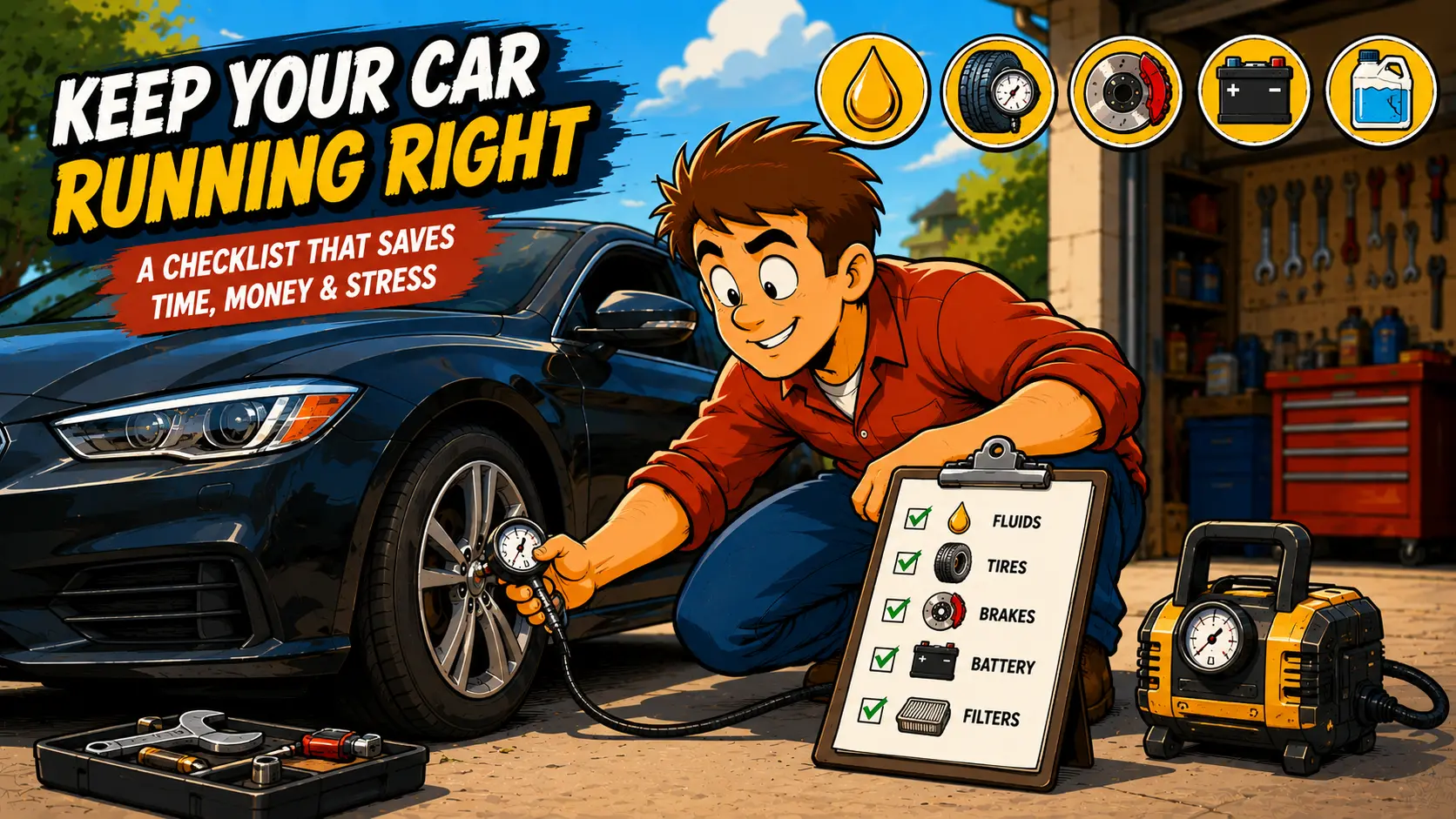
Quick Answer
A complete car maintenance checklist covers monthly visual checks (tire pressure, fluids, lights, wipers), every 3 months service (oil, belts, battery), every 6 months service (tire rotation, brake inspection, cabin filter), annual service (engine air filter, alignment, transmission and coolant check), and long-interval items (spark plugs at 60,000 to 100,000 miles, brake fluid flush every 2 to 3 years, timing belt at 60,000 to 100,000 miles). Use a printable list, work through it on a schedule, and track what you finish.
A car maintenance checklist is the simplest way to keep a vehicle running well, avoid surprise repair bills, and protect resale value. This guide gives you a complete, interactive checklist organized by how often each job needs doing, plus a downloadable PDF you can print and tape inside the garage. Every item links to a deeper guide if you want the full how-to.
No email signup required. The PDF is free, printable, and yours to keep.
Why a Maintenance Checklist Beats a Schedule
A schedule tells you when to do something. A checklist tells you what to actually do today. Most people fall behind on car care not because they don't know intervals, but because the list of jobs feels overwhelming. Breaking everything into short, frequency-based blocks makes it manageable in 15-minute chunks.
If you also want full mileage tables, pair this guide with our car maintenance schedule by mileage. They work together: schedule for the calendar, checklist for the wrench.
How to Use This Checklist
- Save the PDF and print it. Stick it inside the garage or glovebox.
- Use the interactive version below to tick items as you go. Progress saves automatically in your browser.
- Start with monthly checks first. They take 10 minutes and catch 80% of small problems before they get expensive.
- Click any item with a linked guide if you want the step-by-step.
The Interactive Checklist
Ultimate Car Maintenance Checklist
Frequency-based DIY checklist covering monthly, quarterly, semi-annual, annual, and long-interval items.
Ready to start
Monthly (10 to 15 minutes)
Every 3 Months / 3,000 to 5,000 Miles
Every 6 Months / 5,000 to 8,000 Miles
Annually / 12,000 to 15,000 Miles
Long-Interval Items (Don't Skip)
Seasonal Tasks
Item-by-Item: Why Each Job Matters
Quick context for the items above. Click through to the full guide on any line you want to do yourself.
Tire Pressure and Rotation
Low pressure burns fuel, ruins tires, and increases stopping distance. Check monthly when cold. Rotate every 5,000 to 8,000 miles to even out wear. See the tire pressure guide and our DIY tire rotation guide.
Oil and Oil Filter
The single most important service item. Synthetic typically goes 5,000 to 7,500 miles; conventional, 3,000 to 5,000. Full walkthrough in our how to change oil like a pro guide.
Brakes
Inspect pad thickness every 6 months. Squealing, grinding, or longer stopping distance means stop driving and check. Background reading: squeaky brakes, brake pad replacement, and brake rotors.
Air Filters (Engine and Cabin)
Two different filters, two different jobs. A dirty engine filter kills MPG; a dirty cabin filter ruins air quality. See engine air filters, cabin filter replacement, and the side-by-side comparison.
Battery
Most batteries fail at 3 to 5 years. Clean terminals annually and load-test once a year. Our battery maintenance guide covers the full routine, and how to jump start safely if it fails.
Coolant and Cooling System
Overheating destroys engines. Check level monthly, condition annually, flush per manual. See coolant types, cooling leaks, and radiator flush.
Transmission Fluid
Treat this seriously. A botched fluid change is worse than no change at all. Read the transmission fluid change guide first. All vehicle fluids covered in our complete car fluids guide.
Spark Plugs
Replace every 60,000 to 100,000 miles depending on plug type. Old plugs cause misfires, poor MPG, and check engine lights. See spark plug replacement.
Timing Belt
If your engine has a belt (not a chain), this is the highest-stakes item on the list. Failure usually means thousands in engine damage. Timing belt signs and intervals.
Lights, Wipers, and Visibility
Cheap, easy, often ignored. See headlight bulb replacement, faded headlight restoration, and wiper replacement.
Warning Lights
Never ignore a new dashboard light. Decode them with our dashboard warning lights guide, and pull codes yourself with the check engine light diagnosis walkthrough or an OBD2 scanner.
Seasonal Prep
Twice-a-year deep checks beat random ad-hoc maintenance. See winter prep, summer prep, and road-trip prep.
How Often: At-a-Glance
- Every month: tires, fluids, lights, wipers, warning lights
- Every 3 months: oil change (conventional), under-hood inspection
- Every 6 months: tire rotation, brake inspection, cabin filter (annual in clean air)
- Annually: engine filter, alignment, A/C, battery test, transmission and coolant condition
- Every 2 to 3 years: brake fluid flush
- Every 30,000 to 100,000 miles: spark plugs, coolant flush, timing belt, transmission service
First-Time Car Owner? Start Here
If this is your first car or you're returning to DIY after years away, work through our first-time owner maintenance guide alongside this checklist. It covers what tools are worth buying first and how to read your owner's manual without getting lost.
Buying used? The used car pre-purchase checklist is the version of this list to run before you sign anything.
How This Checklist Saves You Money
Preventative maintenance is boring and cheap. Repairs from skipped maintenance are dramatic and expensive. A $40 brake inspection prevents a $1,200 rotor and caliper job. A $30 coolant top-off prevents a $4,000 head gasket. A $90 timing belt service prevents a $5,000 engine rebuild.
For more DIY-versus-shop math, see save money on car repairs.
Frequently Asked Questions
What to Read Next
Car Maintenance Schedule by Mileage
The mileage-based companion to this checklist: every service from 3,000 to 100,000 miles.
How to Change Oil Like a Pro
Save $280 a year with the exact tools, torque specs, and the mistake that destroys engines.
First-Time Car Owner Guide
What to learn first, what tools to buy first, and how to read your owner's manual.
DIY vs Mechanic: When to Save, When to Pay
The real numbers behind which repairs are worth doing yourself and which aren't.
Don't Miss Critical Car Care Tips
Get exclusive guides, money-saving maintenance tips, and early warning signs delivered straight to your inbox.