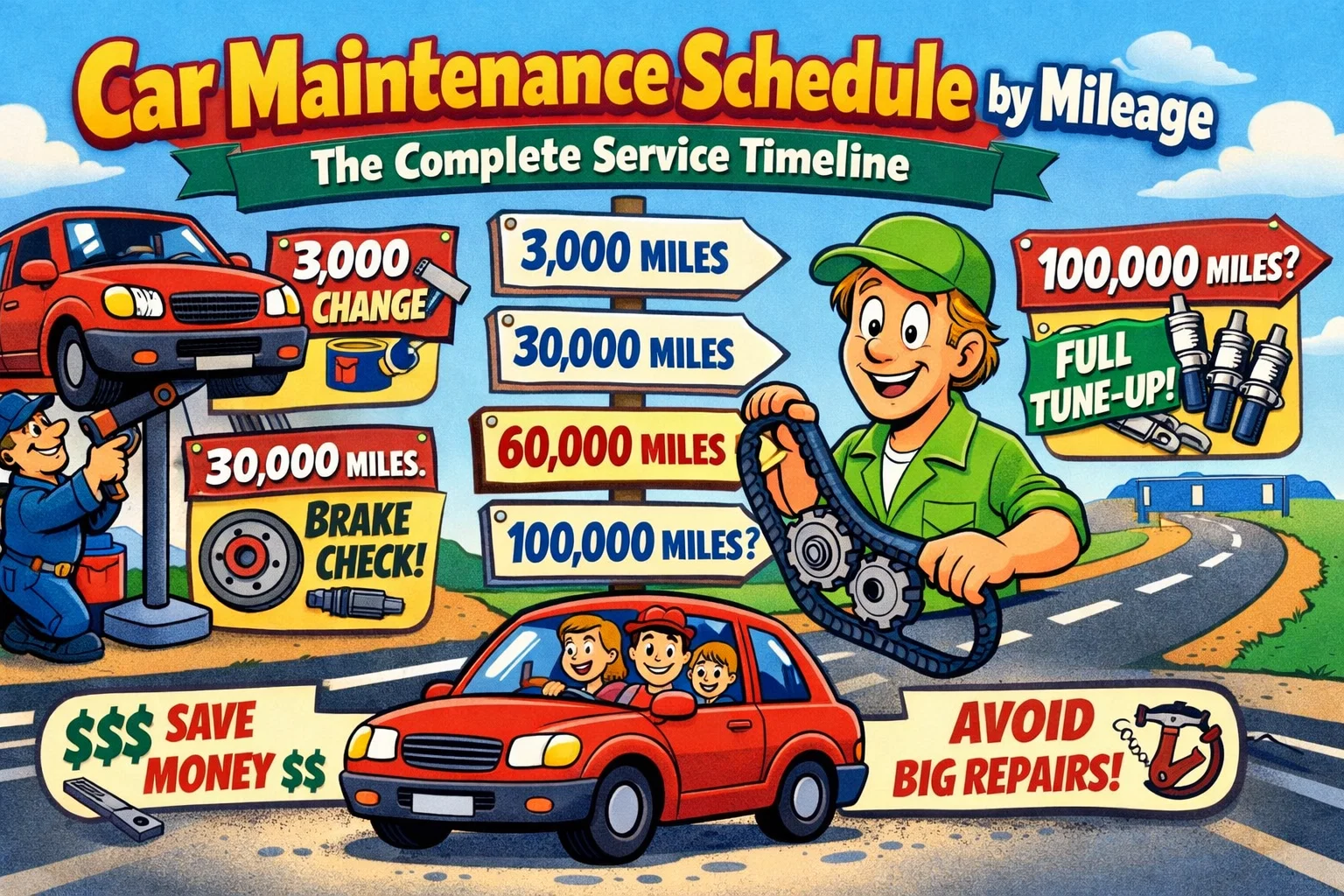
Car Maintenance Schedule by Mileage: The Complete Service Timeline
Quick Answer
Change oil every 5,000 to 7,500 miles, rotate tires every 5,000 to 8,000 miles, replace brake pads at 30,000 to 50,000 miles, flush coolant at 30,000 miles, replace spark plugs at 60,000 to 100,000 miles, and swap the timing belt at 60,000 to 100,000 miles. Always check your owner's manual for model-specific intervals.
Regular maintenance is the key to a reliable, long-lasting vehicle. This comprehensive guide outlines exactly what service your car needs at every major mileage interval, from 3,000 miles to 100,000 and beyond. Follow this schedule to prevent expensive repairs and keep your car running smoothly for years to come.
Why Follow a Maintenance Schedule
The three most important maintenance intervals are oil changes every 5,000 to 7,500 miles, brake inspections at 30,000 miles, and timing belt replacement between 60,000 and 100,000 miles. Following these intervals prevents the most common and expensive repair issues.
Regular maintenance costs a fraction of major repairs. An oil change costs $30 to $75, while engine replacement due to neglect can cost $4,000 to $8,000. A timing belt replacement at $500 to $1,000 prevents catastrophic engine damage worth $3,000 or more.
Your Owner's Manual Always Wins
Service intervals and costs may vary based on your vehicle's specific requirements and local labor rates. Severe driving conditions such as frequent short trips, extreme temperatures, towing, or dusty environments may require more frequent maintenance.
Pro Tip
Routine Maintenance (Every 3,000-7,500 Miles)
These are your most frequent maintenance items. Modern synthetic oils allow longer intervals, but check your owner's manual for specific recommendations.
| Service | Interval | DIY Cost | Shop Cost |
|---|---|---|---|
| Oil & Filter Change | 5,000-7,500 mi | $25-40 | $50-75 |
| Tire Rotation | 5,000-7,500 mi | Free (DIY) | $20-50 |
| Fluid Level Check | Monthly | Free | Included |
| Tire Pressure Check | Monthly | Free | Free |
15,000-30,000 Mile Service
At this interval, you will start replacing some wear items and performing more thorough inspections.
| Service | Interval | DIY Cost | Shop Cost |
|---|---|---|---|
| Engine Air Filter | 15,000-30,000 mi | $15-30 | $40-70 |
| Cabin Air Filter | 15,000-30,000 mi | $15-25 | $50-80 |
| Brake Inspection | 15,000-30,000 mi | Free (visual) | $0-50 |
| Battery Test | 24,000-36,000 mi | Free (stores) | $0-25 |
30,000-60,000 Mile Service
This is where major maintenance items start appearing. Many of these services can prevent expensive repairs down the road.
| Service | Interval | DIY Cost | Shop Cost |
|---|---|---|---|
| Transmission Fluid | 30,000-60,000 mi | $50-100 | $150-300 |
| Brake Pads | 30,000-70,000 mi | $50-100 | $150-300/axle |
| Coolant Flush | 30,000-50,000 mi | $30-50 | $100-150 |
| Spark Plugs | 30,000-100,000 mi | $20-60 | $100-300 |
| Suspension Inspection | 50,000 mi | Free (visual) | $50-100 |
60,000-100,000 Mile Service
The timing belt is the most critical item in this interval. If your vehicle has a timing belt, replacing it on schedule is essential. A broken timing belt can destroy your engine instantly, turning a $500 to $1,000 service into a $3,000 to $8,000 engine replacement.
| Service | Interval | DIY Cost | Shop Cost |
|---|---|---|---|
| Timing Belt | 60,000-100,000 mi | $100-200 | $500-1,000 |
| Water Pump | 60,000-100,000 mi | $50-100 | $300-600 |
| Thermostat | As needed | $20-50 | $150-300 |
| Power Steering Fluid | 75,000-100,000 mi | $15-30 | $100-150 |
| Shocks/Struts | 50,000-100,000 mi | $200-400 | $600-1,200 |
Timing Belt Warning
100,000+ Mile Service
At this mileage, your vehicle needs more comprehensive inspection and potentially some major component replacements. Many well-maintained vehicles easily exceed 200,000 miles.
High-Mileage Inspection Checklist
- ✓ Complete brake system inspection including rotors
- ✓ Suspension component wear assessment
- ✓ Alternator and starter motor condition
- ✓ All belts and hoses inspection
- ✓ Cooling system pressure test
- ✓ Exhaust system inspection
- ✓ CV boots and axle condition
DIY vs Professional Services
DIY maintenance can save you 50 to 70 percent on most services. An oil change that costs $75 at a shop can be done for $30 at home. Brake pad replacement that shops charge $300 for can be completed for under $100 in parts. Over the life of a vehicle, DIY maintenance can save thousands of dollars.
Good for DIY
- • Oil and filter changes
- • Air filter replacement
- • Cabin filter replacement
- • Wiper blade replacement
- • Battery replacement
- • Brake pad replacement
- • Spark plug replacement
- • Coolant flush
Better for Professionals
- • Timing belt replacement
- • Transmission service (complex)
- • AC system work
- • Wheel alignment
- • Suspension work (some)
- • Electrical diagnosis
- • Major engine work
New to working on your own vehicle? Our first-time car owner maintenance guide walks you through the essentials. And for a deeper look at how much DIY work really saves, check out our guide to saving money on car repairs.
Related Maintenance Guides
Replacing parts as part of routine maintenance? Learn where to sell your old but still-usable components in our selling car parts guide.
Dashboard Warning Lights
Know what each warning means
Check Engine Diagnosis
Diagnose trouble codes yourself
Winter Car Prep
Seasonal maintenance essentials
Coolant Types Guide
Choose the right antifreeze
First-Time Car Owner Guide
Essential tips for new car owners
Manual vs. Auto Transmission
Compare maintenance needs
Frequently Asked Questions
Don't Miss Critical Car Care Tips
Get exclusive guides, money-saving maintenance tips, and early warning signs delivered straight to your inbox.