Manual vs. Automatic Transmission: Maintenance Differences
Quick Answer
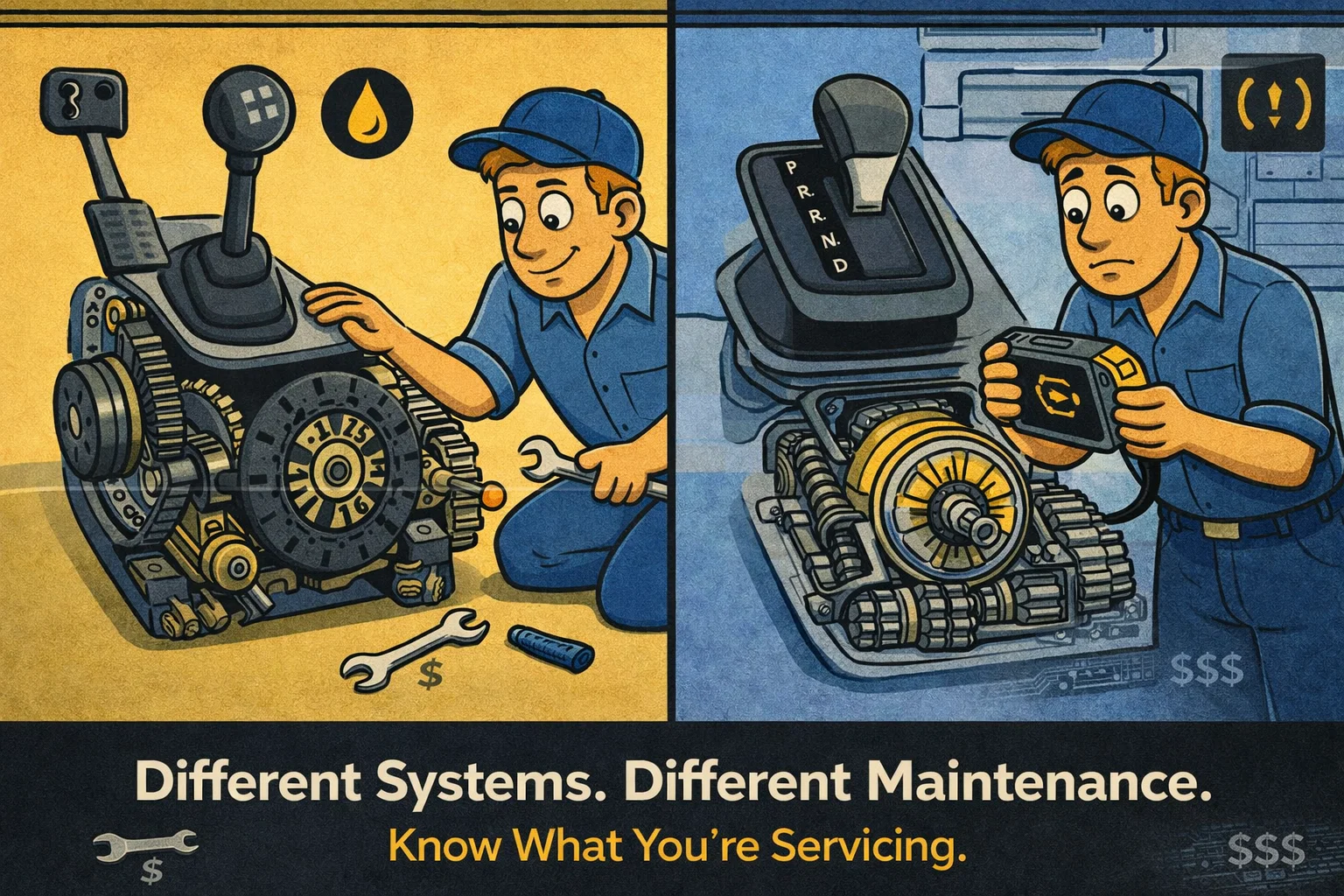
Manual transmissions use gear oil changed every 30,000 to 60,000 miles and need clutch replacement at 60,000 to 100,000 miles ($500 to $1,500). Automatics use ATF changed every 30,000 to 60,000 miles and cost $1,500 to $4,000+ to rebuild if neglected. Manuals are cheaper to maintain overall, but automatics are more convenient.
Manual and automatic transmissions are fundamentally different machines that happen to do the same job. They wear differently, need different fluids, follow different service intervals, and fail in different ways. Whether you are choosing your next car or maintaining the one you have, understanding these differences helps you spend less money and get more life out of your drivetrain.
How Each Transmission Type Works
A manual transmission uses a clutch pedal and gear stick to let the driver select gears manually. An automatic transmission uses a torque converter and planetary gear sets to shift gears without driver input. CVT transmissions use a belt and pulley system with no fixed gears at all. Each design has different maintenance needs, costs, and lifespans.
Manual Transmission
The driver controls everything. A clutch pedal disconnects the engine from the transmission while you move the gear stick to select the next gear. The clutch disc, pressure plate, and throwout bearing are the primary wear items.
Key wear items: Clutch disc, pressure plate, synchros
Automatic Transmission
A torque converter replaces the clutch pedal, and the transmission's computer decides when to shift. Internal clutch packs, bands, and solenoids handle gear changes. More components means more potential failure points, but modern automatics are highly reliable when serviced properly.
Key wear items: Clutch packs, bands, solenoids, torque converter
CVT Transmission
Continuously Variable Transmissions use a steel belt or chain running between two variable-diameter pulleys. There are no fixed gears to shift between, which provides smooth acceleration but requires very specific fluid and careful maintenance.
Key wear items: Belt/chain, pulleys, CVT-specific fluid
Fluid Requirements: The Biggest Difference
The type of fluid your transmission needs is the most critical maintenance detail to get right. Using the wrong fluid is one of the fastest ways to destroy a transmission, regardless of type.
Manual Fluid
- Gear oil (GL-4 or GL-5 rated)
- Some use ATF or motor oil
- Capacity: 2 to 4 quarts
- Change interval: 30,000 to 60,000 miles
Automatic Fluid
- ATF (Dexron, Mercon, ATF+4)
- Types are NOT interchangeable
- Capacity: 8 to 16 quarts total
- Change interval: 30,000 to 60,000 miles
CVT Fluid
- CVT-specific fluid only
- Never use regular ATF
- Capacity: 4 to 8 quarts
- Change interval: 25,000 to 50,000 miles
For a complete walkthrough of the fluid change process for automatics, see our DIY transmission fluid change guide. The process for manual transmissions is simpler since there is no filter to replace, but finding and accessing the fill plug can be tricky on some vehicles.
Critical Fluid Warning
Service Intervals Compared
Service intervals vary by manufacturer, driving conditions, and transmission type. These are general guidelines. Always defer to your owner's manual for exact intervals. For a complete breakdown of all vehicle service intervals by mileage, see our car maintenance schedule guide.
Manual Transmission
- Fluid change: Every 30,000 to 60,000 miles
- Clutch inspection: Every 60,000 miles or when symptoms appear
- Clutch replacement: Typically 60,000 to 100,000 miles (varies greatly by driving style)
- Synchro wear check: When grinding occurs during shifts
Automatic Transmission
- Fluid and filter change: Every 30,000 to 60,000 miles
- Band adjustment: Some older vehicles require periodic adjustment
- Torque converter check: When shuddering occurs at highway speeds
- Solenoid inspection: When erratic shifting is diagnosed
CVT Transmission
- Fluid change: Every 25,000 to 50,000 miles (critical, do not skip)
- Belt/chain inspection: When noise or slipping occurs
- Pulley inspection: During fluid changes if accessible
- Software updates: Check with dealer for TCM (Transmission Control Module) updates
Maintenance Costs Compared
Manual transmissions are generally cheaper to maintain because they have fewer components and simpler fluid requirements. A manual fluid change costs $20 to $50 DIY, while an automatic fluid and filter change runs $50 to $150 DIY. CVT fluid changes cost $30 to $80 DIY but the fluid itself is more expensive.
Manual (DIY Annual Cost)
$20 to $80
Fluid changes only
Automatic (DIY Annual Cost)
$50 to $150
Fluid + filter changes
CVT (DIY Annual Cost)
$60 to $120
Specialized fluid changes
Major Repair Costs
When things go wrong, the cost differences become more significant. Manual transmission repairs tend to be cheaper because the primary failure point (the clutch) is external and accessible. Automatic transmission problems often require removing the entire unit.
Manual Repair Costs
- Clutch replacement: $500 to $1,200
- Synchro repair: $400 to $800
- Throwout bearing: $200 to $400
- Full rebuild: $1,200 to $2,500
Automatic Repair Costs
- Solenoid replacement: $150 to $400
- Torque converter: $500 to $1,000
- Clutch pack replacement: $800 to $1,500
- Full rebuild: $1,800 to $3,500
Wondering whether a repair is worth the cost? If the repair exceeds 50% of the vehicle's value, it might be time to consider other options. Our transmission slipping guide helps you diagnose whether you are dealing with a simple fix or a major repair.
DIY Feasibility: What Can You Do Yourself?
One of the biggest practical differences between manual and automatic transmissions is how much maintenance you can realistically handle at home.
Manual: High DIY Potential
- Fluid change: Easy. Drain plug access, refill via fill plug. No filter.
- Clutch adjustment: Some vehicles allow cable or hydraulic adjustment.
- Clutch replacement: Advanced DIY. Requires transmission removal.
Automatic: Moderate DIY Potential
- Fluid and filter change: Intermediate. Pan removal, filter swap, refill.
- Solenoid replacement: Advanced. Accessible on some models via pan.
- Internal repairs: Professional only. Requires specialized tools and knowledge.
For a detailed walkthrough of the automatic fluid change process, follow our step-by-step transmission fluid change guide. The process covers pan removal, filter replacement, gasket installation, and proper refill procedures.
Lifespan and Reliability
With proper maintenance, both transmission types can last well beyond 200,000 miles. The key variable is not the type of transmission but how consistently you maintain it.
Manual Lifespan
150,000 to 250,000+
miles (clutch replaced once)
Automatic Lifespan
150,000 to 300,000+
miles (with regular fluid service)
CVT Lifespan
100,000 to 200,000
miles (improving with newer designs)
The Single Biggest Factor in Transmission Longevity
Common Failure Symptoms by Type
Knowing how each transmission type fails helps you catch problems early. The symptoms overlap in some areas but are distinct in others.
Manual Failure Signs
- Grinding when shifting gears (worn synchros)
- Clutch pedal vibration or chatter (worn disc)
- High RPM without acceleration (slipping clutch)
- Difficulty getting into or staying in gear
- Burning smell from clutch area
Automatic Failure Signs
- Delayed or harsh shifts (worn clutch packs)
- Slipping between gears (multiple causes)
- Shuddering at highway speeds (torque converter)
- Fluid leak under car (seals or gaskets)
- Check engine light with P07xx codes
For a deeper dive into automatic transmission slipping symptoms and their causes, read our transmission slipping guide. For warning light interpretation, see our dashboard warning lights guide.
Which Is Better for DIY Owners?
If you enjoy working on your own car and want to handle as much maintenance as possible yourself, manual transmissions give you more opportunities to get involved. Fluid changes are simpler, clutch feel gives you early warning of wear, and the mechanical simplicity makes diagnosis more straightforward.
That said, automatic transmissions are not off-limits for DIYers. A fluid and filter change is a solid intermediate project that saves $100 to $200 over shop pricing. The key is knowing your limits: fluid changes and basic diagnostics are DIY territory, while internal repairs require professional tools and expertise.
CVT transmissions are the least DIY-friendly of the three. The fluid is expensive, the tolerances are tight, and mistakes can be costly. Unless you have specific experience with CVTs, stick to professional service for anything beyond a fluid change.
What to Read Next
DIY Transmission Fluid Change
Step-by-step guide to changing your automatic transmission fluid and filter at home. Save $100 to $200 on this essential service.
Transmission Slipping Guide
Diagnose why your transmission is slipping with our 5-step process. Covers symptoms, causes, and DIY fixes.
Car Maintenance Schedule
Every service interval mapped by mileage, including transmission fluid, oil, brakes, and cooling system.
Dashboard Warning Lights
Decode every warning symbol including the transmission temperature light before it becomes an emergency.
How to Check Transmission Fluid
The ten-minute dipstick check, what each fluid color means, and what a change should cost.
Frequently Asked Questions
Don't Miss Critical Car Care Tips
Get exclusive guides, money-saving maintenance tips, and early warning signs delivered straight to your inbox.