Shock Absorbers vs. Struts: What's the Difference?
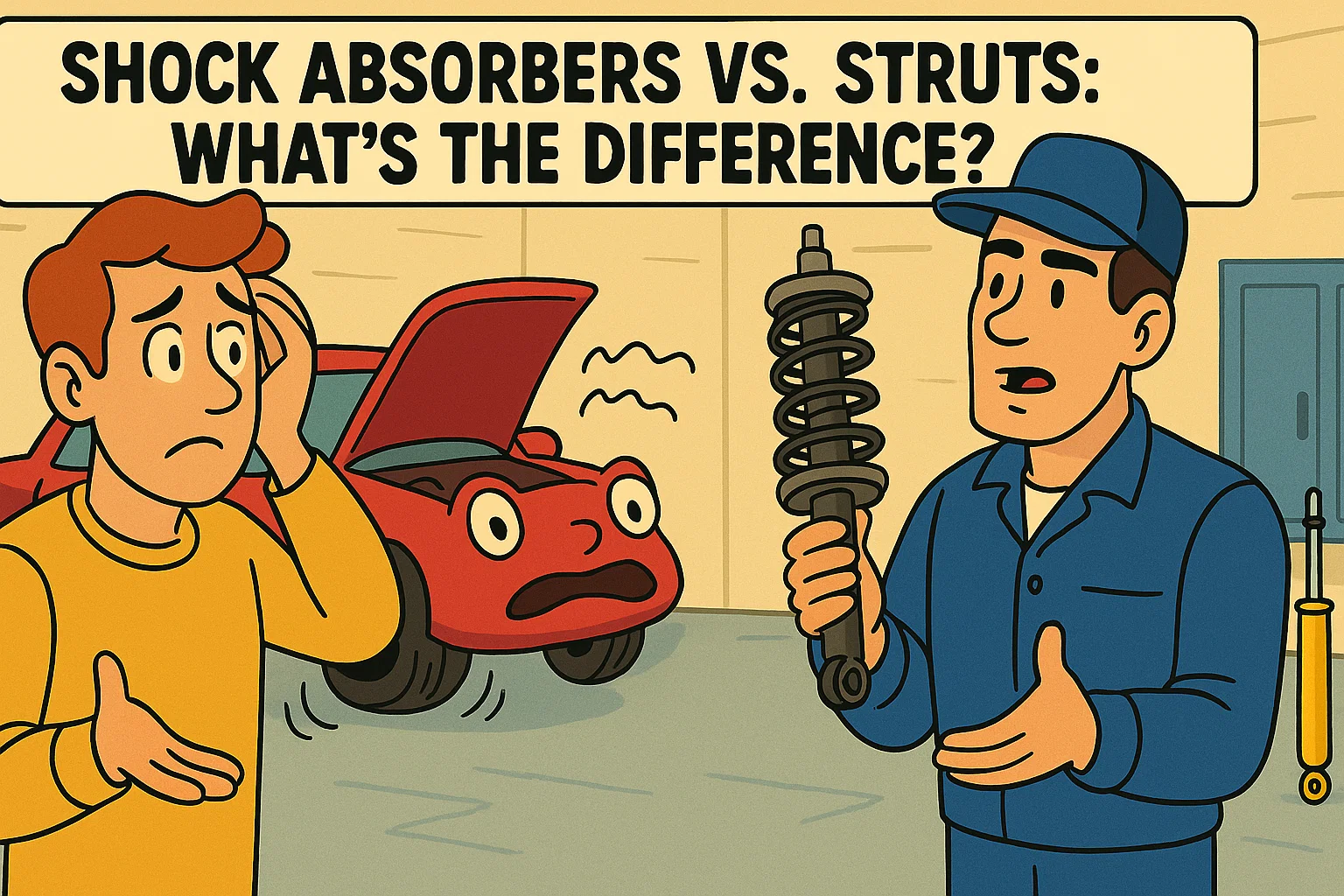
Alt Text: A perplexed driver, standing beside his bouncing red car with its hood open, listens as a mechanic explains the difference between a shock absorber and a strut.
Quick Answer
Shocks and struts both dampen bouncing, but struts are a structural part of the suspension (they replace the upper control arm and spring mount), while shocks are standalone dampers. You cannot swap one for the other. Replace shocks/struts every 50,000 to 100,000 miles or when your car bounces excessively, nose-dives when braking, or shows uneven tire wear.
Picture this: You're cruising down the highway when your car starts bouncing like a carnival ride. Your mechanic takes one look and throws around terms like "struts need replacing" and "alignment required." The estimate? A cool $1,200. Your first thought: What exactly am I paying for, and is this guy speaking English?
Welcome to the confusing world of suspension repairs, where shocks and struts get mixed up more often than a toddler's toy box. By the time you finish reading this, you'll know exactly what's under your car, what's broken, and whether that quote is fair or highway robbery.
The Simple Truth: They're Not the Same Thing
Here's what most people don't realize: shocks and struts are completely different animals, even though they both control your car's bouncing. Think of it like comparing a security guard to a building's support beam. Both keep things stable, but one just watches while the other actually holds everything up.
Quick Visual Test
Want to know what you're dealing with? Pop your hood and look toward the front wheels:
Visual Identification Guide
If you see struts: You'll spot a big, tower-like assembly that looks like it's actually supporting the car. It's thick, obvious, and connects directly to a metal tower in your engine bay.
If you see shocks: They're sneakier. These slim cylinders hide behind or near the wheels, looking more like heavy-duty bike shocks. They're there to dampen movement, not hold up the world.
The 90% Rule: Most front-wheel-drive cars use struts up front and shocks in the back. It's not foolproof, but it's right nine times out of ten.
What Each Actually Does
Shock absorbers are the strong, silent type. They have one job: control spring bounce. When you hit a bump, your springs compress and want to keep bouncing like a pogo stick. Shocks say "nope" and calm everything down. That's it. They don't support weight, don't affect steering, just keep you from feeling seasick.
Struts are the overachievers. They dampen bouncing like shocks, but they also support the car's weight and serve as a steering pivot point. Remove a strut, and your car literally falls down on that corner. They're structural components disguised as suspension parts.
Why Struts Cost More
Does My Car Have Shocks, Struts, or Both?
The 30-Second Check
Method 1: Owner's Manual (Most Reliable)
Flip to the suspension section or parts diagram. The manufacturer never lies about what they installed.
Method 2: Pop the Hood (Visual Confirmation)
Look at the front wheels from the engine bay. See those tower-like assemblies? Those are strut towers, which means you have struts. No towers? You've got shocks hiding somewhere.
Method 3: The FWD Shortcut (90% Accurate)
If you drive a front-wheel-drive car (Honda Civic, Toyota Camry, most sedans), you probably have struts in front and shocks in the rear. Trucks and SUVs mix it up more.
Vehicle Examples That Actually Matter
- •Honda Civic (2016): Struts front, shocks rear. Classic FWD setup.
- •Toyota Camry (2006-2011): Struts all around for sedans. This is why Camry suspension jobs cost more.
- •Ford F-150 (2015): Struts up front, shocks in back. Heavier trucks need the structural support of struts to handle the weight.
The pattern? Manufacturers put struts where they need structural support and steering precision, shocks where they just need bounce control.
Symptom Decoder: What's Actually Broken?
Three symptoms require immediate shop attention: oil leaking from the damper body, severe nose-diving during braking, and tire cupping wear patterns. You can wait a few weeks if you notice mild floatiness, slightly bouncy ride after speed bumps, or the car feeling "loose" but still controllable. Inspect dampers every 12,000 miles and plan for replacement between 50,000 and 100,000 miles.
Not all suspension problems are created equal. Some mean "drive straight to the shop," others mean "schedule an appointment next week."
Emergency Red Flags
Stop Driving Immediately
- Oil leaking from the damper body: This is suspension failure in progress. The internal seals have blown, and the unit can't do its job anymore. Don't wait.
- Severe nose-dive during braking: Your front struts are toast. When you can't stop without your car doing an impression of a diving whale, that's dangerous territory.
- Tire "cupping" wear: Those weird scalloped wear patterns on your tires? That's from dampers that can't keep the tire planted on the road. Replace the dampers, or keep buying tires every six months.
"Can I Wait?" Symptoms
- •Mild floatiness over 60,000 miles: Your car feels a bit loose and bouncy, but it's still controllable. Schedule replacement within a month or two.
- •Slightly bouncy after speed bumps: One or two extra bounces after hitting a bump isn't ideal, but it's not dangerous if everything else feels normal.
- •Car feels "loose" but controllable: When the steering feels less precise and the ride quality has gradually declined, you're in the "should replace soon" category.
The Money Talk: Why Struts Cost More
Price Reality Check
Here's where it gets expensive, and understanding why helps you budget correctly:
- •Shocks: $400 to $1,000 per pair (parts plus labor)
- •Struts: $450 to $2,600 per pair depending on your vehicle
Why the huge range? A basic Honda Civic strut job costs way less than replacing struts on a BMW X5. Luxury cars have more complex assemblies and higher parts costs.
The Strut Premium Explained
Struts cost more because they're not just dampers. Each strut assembly includes:
- •The shock absorber portion
- •A coil spring
- •Upper mount and bearing
- •Structural components
Plus, strut replacement often requires special tools to compress springs safely, or you buy "loaded" assemblies that come pre-assembled (easier but pricier).
Hidden Costs Nobody Warns You About
Budget for These Extras
- Alignment required: Front strut replacement changes your car's geometry. Plan on another $100 to $150 for alignment, or your new tires will wear unevenly.
- The pair rule: Never replace just one shock or strut. Mixing fresh and worn dampers on the same axle creates handling imbalances and accelerates wear on the new part.
Safety First: Can You Keep Driving?
The honest answer: yes, but with serious caveats.
Worn shocks and struts increase braking distances by up to 20%. That doesn't sound like much until you're sliding into an intersection because you couldn't stop in time. Wet weather handling gets particularly sketchy because the tires can't maintain proper contact with the pavement.
Timeline Guidance
- •Drive immediately to the shop: Visible oil leaks, severe clunking noises, or dangerous handling changes.
- •Schedule within two weeks: Bouncy ride, mild handling issues, or if you're over 75,000 miles and experiencing symptoms.
- •Plan ahead: Even without obvious symptoms, inspect dampers every 12,000 miles and budget for replacement around 50,000 to 100,000 miles depending on your driving conditions.
Replacement Strategy That Saves Money
The Non-Negotiable Pair Rule
Always replace shocks and struts in pairs on the same axle. Here's why: if one side is worn enough to need replacement, the other side isn't far behind. Mixing a fresh damper with a tired one creates an imbalanced ride and accelerates wear on both sides.
You don't have to do all four at once, though. Front and rear can be done separately as needed.
DIY vs. Professional Decision Tree
DIY Recommendations
- Rear shocks: Perfect weekend warrior territory. Most require just two bolts per side, basic tools, and a couple hours. YouTube has excellent tutorials for specific vehicles.
- Front struts: Buy "loaded" assemblies (pre-assembled with springs) if you're doing it yourself. This avoids the dangerous spring compression process. Expect to need an alignment afterward.
- When to go professional: If you see terms like "coil spring compressor required" or your car has electronic dampers, let the pros handle it.
Cost-Saving Strategies
- •Online parts shopping: Quality loaded strut assemblies often cost $100 to $250 each online versus $300+ at the shop. Many mechanics will install customer-provided parts for a reasonable labor charge.
- •Bundle services: Combine suspension work with scheduled brake service or tire replacement. You'll save on the alignment charge and labor overlap.
- •Timing matters: If you're planning major service work, knock out the suspension at the same time to share costs.
Red Flags When Shopping for Repairs
Quote Warning Signs
Watch Out For These Red Flags
- Mechanic says "shocks" but quotes strut prices: This creates confusion and sticker shock. Always ask specifically which components need replacement.
- Pressure to replace all four immediately: Unless you're experiencing severe symptoms on all corners, front and rear can often be done separately based on actual wear.
- No mention of alignment: If they're replacing front struts and don't mention alignment, they either don't know what they're doing or they're hoping you won't notice the uneven tire wear later.
Smart Shopping Questions
- •"Are these shocks or struts, and what's included in that price?"
- •"Do you install customer-provided parts, and what's your labor rate?"
- •"Is alignment included, or is that separate?"
- •"What's the warranty on parts and labor?"
Get specific part numbers if possible. This lets you price-shop online and verify you're getting OEM-equivalent quality.
The Bottom Line for Busy Drivers
Your Action Plan
- •Identify your setup before calling shops. Know whether you have shocks, struts, or both.
- •Budget appropriately for your vehicle type. Luxury cars cost more, trucks fall in the middle, economy cars are cheapest.
- •Prioritize safety over small savings. Worn suspension components affect braking and handling in ways that can't be ignored.
- •Replace in pairs and plan for alignment if you're doing front struts.
When to Act
- •This week: Visible oil, clunking noises, or severe handling problems
- •This month: Bouncy ride, minor tire wear, or high mileage with symptoms
- •Next service interval: Preventive replacement if you're approaching 75,000 to 100,000 miles
Remember, suspension components wear gradually. By the time you notice problems, they've been declining for thousands of miles. Don't wait for complete failure; your safety and wallet will thank you for being proactive.
The difference between shocks and struts might seem technical, but understanding it saves money and keeps you safer on the road. Next time a mechanic starts talking suspension, you'll know exactly what they mean and whether their recommendations make sense.
Frequently Asked Questions
Don't Miss Critical Car Care Tips
Get exclusive guides, money-saving maintenance tips, and early warning signs delivered straight to your inbox.