First-Time Car Owner's Maintenance Guide
Quick Answer
As a new car owner, focus on five things: check your oil monthly, maintain tire pressure, follow the maintenance schedule in your owner's manual, learn to recognize warning lights, and keep an emergency kit in the trunk. These basics prevent 90% of common breakdowns.
Congratulations on your first car. Whether you bought it brand new or picked up a trusty used ride, taking care of it does not have to be intimidating. This guide strips away the jargon and gives you a clear, practical roadmap for the maintenance tasks every car owner needs to know. Follow these basics and your car will reward you with years of reliable service.
Why Maintenance Matters (Even for New Cars)
Regular maintenance is the single biggest factor in how long your car lasts and how much it costs to own. A well-maintained vehicle can easily run 200,000 miles or more. A neglected one might start costing you serious money before it hits 100,000. The difference between those two outcomes usually comes down to a handful of simple tasks done on schedule.
Think of maintenance like brushing your teeth. Each individual task is quick and inexpensive. Skip it long enough, though, and you end up with a problem that costs 10 to 50 times more to fix. A $40 oil change prevents a $4,000 engine replacement. A $20 coolant top-off prevents a $1,500 head gasket repair. The math is always in your favor when you stay ahead of problems.
Our complete maintenance schedule by mileage breaks down every service interval in detail. But if you are just getting started, the five areas below are where you should focus first.
The 5 Essential Maintenance Tasks
Every car owner should master five core maintenance areas: oil changes, tire care, brake inspection, battery health, and air filter replacement. These five tasks account for roughly 80% of preventable breakdowns and can save you $1,000 or more per year in repair costs when done on schedule.
Oil Changes: Your Engine's Lifeline
Engine oil lubricates, cools, and cleans the moving parts inside your engine. Over time, oil breaks down and collects contaminants that turn it from golden and slippery to dark and gritty. Running old oil is like running your engine on sandpaper.
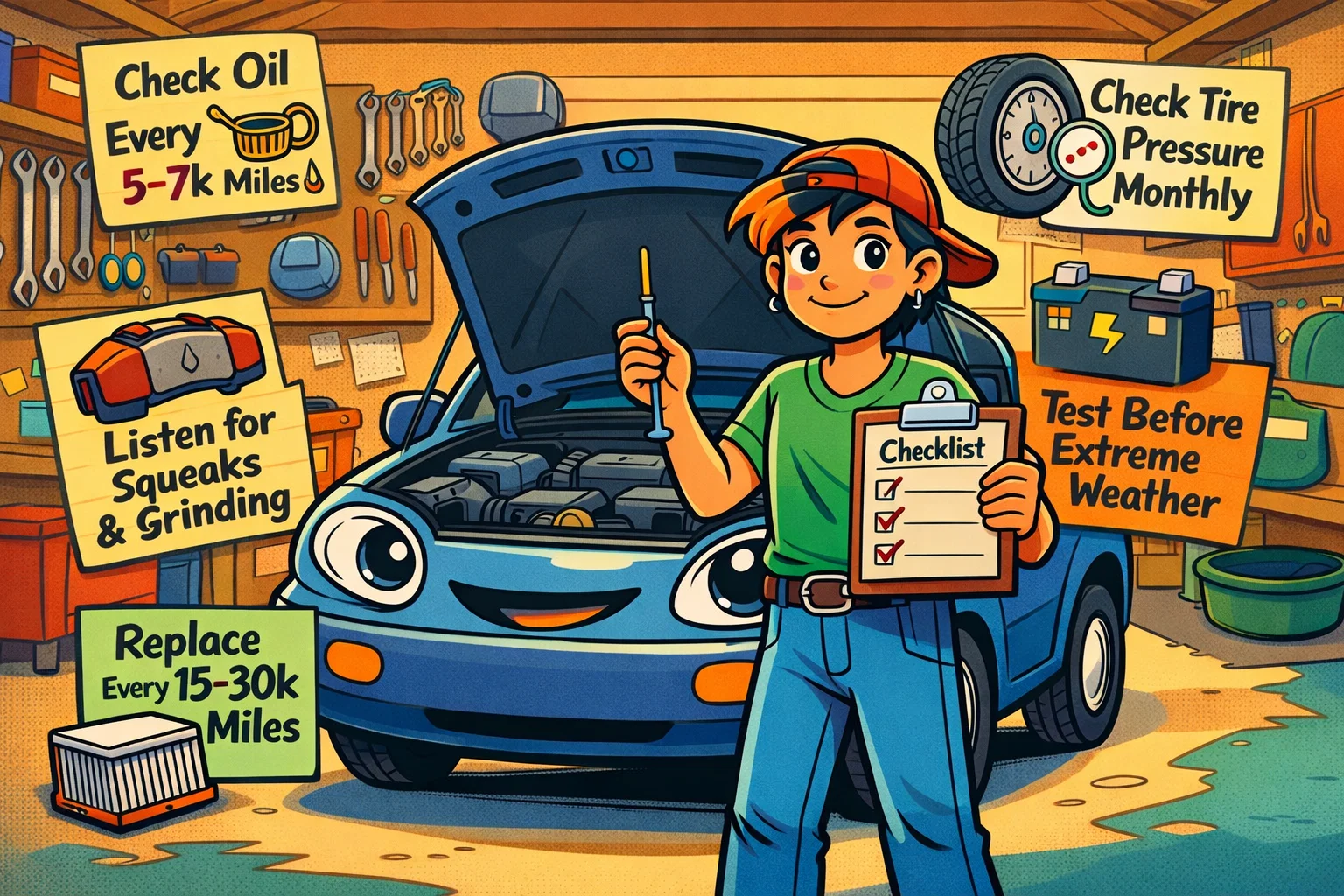
When to change it: Every 5,000 to 7,500 miles for conventional oil, or every 7,500 to 10,000 miles for full synthetic. Check your owner's manual for the exact interval. Some newer cars have oil life monitors that tell you when it is time.
DIY savings: An oil change at a shop costs $40 to $75. Doing it yourself costs $25 to $40 in supplies. Over a year, that saves $60 to $140. Our oil change guide walks you through the entire process.
Pro Tip for New Owners
Tire Care: Safety and Savings
Your tires are the only part of your car that actually touches the road. Proper tire maintenance affects your safety, fuel economy, and handling. Three things matter most: pressure, tread depth, and rotation.
Tire pressure: Check it monthly with a $5 gauge from any auto parts store. The correct pressure is printed on a sticker inside your driver's door jamb (not on the tire sidewall, which shows the maximum pressure). Underinflated tires waste fuel and wear unevenly. Overinflated tires reduce grip and ride comfort.
Tire rotation: Rotate your tires every 5,000 to 8,000 miles to ensure even wear. This extends tire life by up to 20%, saving you $200 to $400 over the life of a set. Our tire rotation guide covers patterns for FWD, RWD, and AWD vehicles.
Tread depth: Insert a penny into the tread with Lincoln's head facing down. If you can see the top of his head, your tread is below 2/32" and the tires need replacement. Worn tires dramatically increase stopping distance, especially in rain.
Brake Inspection: Non-Negotiable Safety
Your brakes are the most critical safety system on your car. The good news is that they give clear warning signs before they fail completely. Learning to recognize those signs can prevent accidents and save you from expensive rotor damage.
Warning signs to watch for: Squealing or grinding noise when braking, the car pulling to one side, a pulsating brake pedal, or the brake pedal feeling soft or spongy. Any of these means it is time for an inspection.
Replacement interval: Brake pads typically last 25,000 to 65,000 miles depending on your driving style and environment. City driving with frequent stops wears pads faster than highway cruising.
Replacing brake pads yourself saves $150 or more per axle. Our brake pad replacement guide covers the full process with safety precautions.
Battery Health: Avoid Getting Stranded
A dead battery is the number one cause of roadside breakdowns. Most car batteries last 3 to 5 years, but extreme temperatures (both hot and cold) can shorten that lifespan significantly. A few simple checks can help you avoid being stranded.
Visual inspection: Pop the hood and look at your battery terminals. White, green, or blue crusty buildup means corrosion, which weakens the electrical connection. Clean the terminals with a wire brush and a baking soda solution.
Voltage check: A healthy battery reads 12.4 to 12.7 volts with the engine off. Below 12.2 volts means the battery is undercharged. Below 12.0 volts means it is likely failing. Most auto parts stores will test your battery for free.
Our battery troubleshooting guide covers testing, jump-starting, and when to replace vs. recharge.
Air Filter Replacement: Breathe Easy
Your engine air filter prevents dust, pollen, and debris from entering the engine. A clogged filter restricts airflow, reducing fuel efficiency by 2% to 10% and robbing your engine of power. The cabin air filter does the same job for the air you breathe inside the car.
Replacement interval: Engine air filters should be replaced every 15,000 to 30,000 miles (or sooner in dusty environments). Cabin filters follow a similar schedule. Both are among the easiest DIY tasks on any car.
A new engine air filter costs $10 to $25 and takes less than 5 minutes to install. No tools required on most vehicles. Our air filter guide covers types, selection, and installation.
Understanding Your Dashboard Warning Lights
Your dashboard is your car's way of communicating with you. Those little icons that light up are not there to annoy you. They are genuine warnings that something needs attention. As a new car owner, learning the critical warning lights could save you from a breakdown or even prevent engine damage.
Red lights mean stop driving and address the issue immediately. These include the oil pressure warning, temperature warning, and brake system warning. Yellow or amber lights mean something needs attention soon but is not immediately dangerous. The check engine light and tire pressure monitor fall into this category.
Our dashboard warning lights guide covers every common symbol and what action to take for each one. Bookmark it on your phone for quick reference.
Building Your First Toolkit
You do not need a professional mechanic's tool collection to handle basic maintenance. A small, targeted toolkit covers 90% of what a new car owner will ever need. Here is what to start with:
🔧 Essential Tools ($50 to $80)
- Socket set (3/8" drive, metric and SAE)
- Combination wrench set
- Tire pressure gauge
- Jack and jack stands (often included with car)
- Flashlight or headlamp
- Funnel set
- Oil drain pan
🧴 Supplies to Keep on Hand ($30 to $50)
- 1 quart of your car's oil type (for top-offs)
- Coolant/antifreeze (premixed)
- Windshield washer fluid
- Shop towels or rags
- Battery terminal cleaner
- Tire inflator or portable air compressor
Money-Saving Tip
Your Owner's Manual: The Most Underrated Tool
Your owner's manual is the single most useful document you own as a car owner. It tells you exactly what maintenance your specific vehicle needs and when. Every car is different, and the manual is written by the people who engineered your particular model.
Key information in your owner's manual includes: oil type and capacity, tire pressure specifications, recommended service intervals, fuse box locations and diagrams, warning light explanations, and fluid specifications for every system. If you did not receive a manual with a used car, you can usually find a free PDF version on the manufacturer's website. The Car Care Council also offers a free guide covering basic vehicle systems and maintenance intervals.
Seasonal Maintenance Basics
Different seasons put different stresses on your car. As a new owner, knowing what to check at the start of winter and summer can prevent costly surprises.
❄️ Before Winter
- Test battery (cold starts demand more power)
- Check antifreeze concentration
- Inspect tire tread depth (or switch to winter tires)
- Replace wiper blades
- Stock an emergency kit: blanket, flashlight, scraper
Full details in our winter prep guide.
☀️ Before Summer
- Test AC system for cold air output
- Check coolant level and condition
- Inspect tire pressure (heat increases pressure)
- Replace cabin air filter for fresh air
- Check belt condition (heat accelerates wear)
Full details in our summer prep guide.
Common First-Time Owner Mistakes
Even careful owners make mistakes when they are learning. Here are the most common ones and how to avoid them:
Ignoring the check engine light
It might be something minor like a loose gas cap, but it could also signal a catalytic converter or sensor failure. Get the code scanned (free at most auto parts stores) and address it promptly. Our check engine light guide explains every common code.
Skipping oil changes
Oil breaks down over time even if you do not drive much. Time-based intervals matter just as much as mileage-based ones. If your car sits for months, change the oil at least once a year regardless of mileage.
Using the wrong fluids
Not all oil, coolant, or transmission fluid is the same. Using the wrong type can cause seal damage, corrosion, or reduced performance. Always check your owner's manual for the correct specifications.
Driving on underinflated tires
Low tire pressure wastes fuel, causes uneven wear, and increases the risk of a blowout. Check pressure at least once a month and before long trips. The correct pressure is on the door jamb sticker, not the tire sidewall.
When to DIY vs. When to Visit a Mechanic
As a new car owner, it is completely fine to start with the easiest tasks and gradually build your skills. Here is a quick breakdown of what most beginners can handle versus what is better left to professionals:
| Task | DIY Friendly? | Typical Savings |
|---|---|---|
| Oil change | ✅ Yes, great starter project | $30 to $50 per change |
| Air filter replacement | ✅ Yes, 5 minutes, no tools | $15 to $30 |
| Tire rotation | ✅ Yes, with jack and stands | $25 to $50 |
| Brake pad replacement | ⚠️ Intermediate DIY | $150+ per axle |
| Timing belt replacement | ❌ Professional recommended | N/A (risk too high) |
| Transmission service | ⚠️ Intermediate to advanced | $100 to $200 |
For a deeper dive into the DIY vs. mechanic decision for every common repair, check out our guide to saving money on car repairs.
Creating Your Maintenance Schedule
The easiest way to stay on top of maintenance is to create a simple schedule based on your mileage. Here is a quick-reference chart for the most important intervals:
| Mileage Interval | What to Do |
|---|---|
| Every 5,000 to 7,500 miles | Oil change, tire rotation, visual inspection |
| Every 15,000 to 30,000 miles | Air filter, cabin filter, brake inspection |
| Every 30,000 to 60,000 miles | Transmission fluid, coolant flush, spark plugs |
| Every 60,000 to 100,000 miles | Timing belt (if equipped), brake fluid flush, suspension check |
For the complete breakdown with specific tasks at every milestone, see our full maintenance schedule guide.
What to Read Next
Car Maintenance Schedule by Mileage
The complete interval chart for every service your car needs from 3,000 to 100,000+ miles.
How to Change Oil Like a Pro
Start with the most impactful DIY task. Step-by-step guide with pro techniques.
Dashboard Warning Lights Explained
Know exactly what every symbol on your dash means and what action to take.
Save Money on Car Repairs: DIY vs. Mechanic
Real dollar comparisons for every common repair with a decision framework.
Frequently Asked Questions
Don't Miss Critical Car Care Tips
Get exclusive guides, money-saving maintenance tips, and early warning signs delivered straight to your inbox.