Understanding Coolant Types: A Complete Guide to Antifreeze
Quick Answer
There are three main coolant types: IAT (green, for older vehicles), OAT (orange/red, for GM and newer cars), and HOAT (yellow/turquoise, for Ford and Chrysler). Never mix types. Check your owner's manual for the correct specification. Using the wrong coolant can corrode engine internals and cause overheating.
Using the wrong coolant in your vehicle can cause serious damage to your engine and cooling system components. With multiple formulations on the market, each designed for specific engine materials and technologies, understanding the differences is essential for proper maintenance. This guide explains the three main coolant types and helps you identify which one your vehicle requires.
Why Coolant Type Matters
Engine coolant does more than prevent freezing in winter. It raises the boiling point of your cooling system, protects against corrosion, lubricates the water pump, and prevents scale buildup. Different engine materials require different protective additives, which is why multiple coolant formulations exist. Coolant standards are maintained by ASTM International, which sets the testing benchmarks manufacturers follow.
Modern engines use a variety of metals including cast iron, aluminum, copper, brass, and various alloys. Each material has different corrosion characteristics, and the wrong coolant can actually accelerate corrosion rather than prevent it.
Mixing Coolants
The Three Main Coolant Types
There are three main coolant types: IAT (green, 2 year life, for older vehicles), OAT (orange/red, 5 year life, for GM and European vehicles), and HOAT (various colors, 5 year life, for most modern vehicles). Never mix different coolant types as it can cause corrosion and deposits.
IAT (Inorganic Additive Technology)
Color: Traditional green
Service Life: 2 years or 30,000 miles
IAT coolant is the original formula that has been used for decades. It contains silicates and phosphates that provide a protective coating on metal surfaces. This type works well with older vehicles that have copper and brass radiators along with cast iron engine blocks.
Common Applications: Most domestic vehicles manufactured before 2000, older import vehicles, and classic cars.
Limitations: The protective additives deplete relatively quickly, requiring more frequent changes. Silicates can also be abrasive to water pump seals over time.
OAT (Organic Acid Technology)
Color: Orange, red, or pink (varies by manufacturer)
Service Life: 5 years or 150,000 miles
OAT coolant uses organic acids instead of silicates and phosphates for corrosion protection. These acids provide long-lasting protection without depleting as quickly as traditional additives. General Motors introduced Dex-Cool, an OAT formulation, in 1995.
Common Applications: GM vehicles from 1995 onward, many European vehicles, and some Asian manufacturers.
Limitations: OAT coolant is not compatible with traditional green coolant. Some earlier Dex-Cool formulations were associated with intake manifold gasket issues, though reformulated versions have addressed these concerns.
HOAT (Hybrid Organic Acid Technology)
Color: Yellow, turquoise, pink, blue, or purple (varies widely)
Service Life: 5 years or 150,000 miles
HOAT coolant combines organic acids with a small amount of silicates or phosphates. This hybrid approach provides quick initial protection from the inorganic additives while the organic acids deliver long-term corrosion prevention.
Common Applications: Chrysler, Ford, and many European and Asian manufacturers including BMW, Mercedes-Benz, Volvo, Toyota, and Honda.
Variations: Some manufacturers use phosphate-free HOAT formulas for regions with hard water, as phosphates can combine with minerals to form scale deposits.
Coolant Color Reference Guide
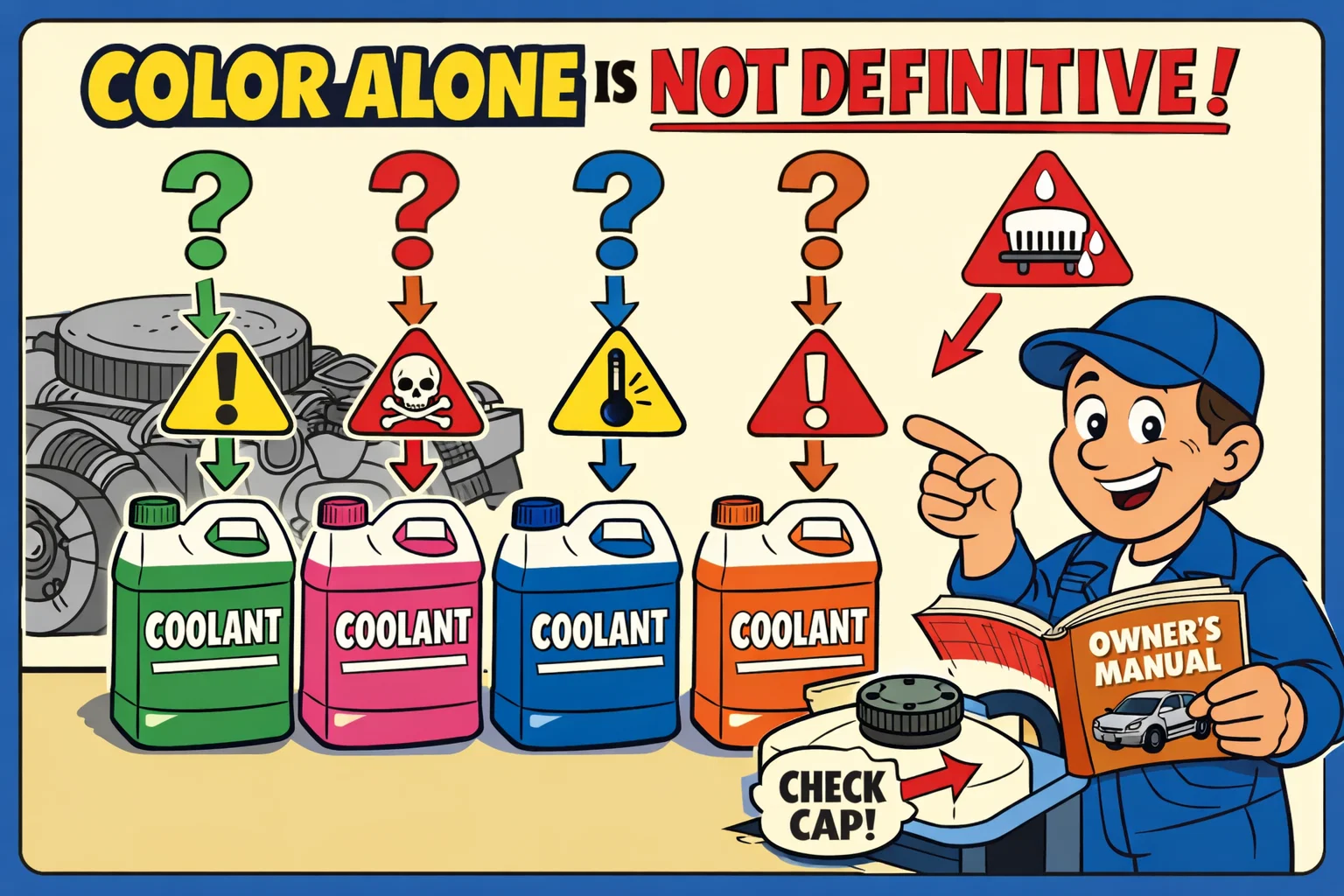
Color Is Not Definitive
| Color | Likely Type | Common Vehicles |
|---|---|---|
| Green | IAT | Older domestic and import vehicles |
| Orange | OAT (Dex-Cool) | GM vehicles 1995 and newer |
| Yellow | HOAT | Hyundai, Kia, some Ford models |
| Pink | OAT or HOAT | Toyota, Lexus, Scion, some Audi |
| Red | OAT or HOAT | Honda, Nissan, some European |
| Blue | HOAT | Honda, Acura, Subaru, some European |
| Purple | HOAT | Some European vehicles |
How to Identify the Correct Coolant for Your Vehicle
Check Your Owner's Manual
The owner's manual specifies the exact coolant type and often lists acceptable brands. This is the most reliable source of information.
Examine the Coolant Reservoir Cap
Many vehicles have the coolant specification printed directly on the reservoir cap or near the filler neck.
Contact Your Dealer
The dealership service department can look up the exact specification for your vehicle using the VIN.
Use a Parts Store Database
Auto parts stores have databases that list the correct coolant for specific year, make, and model combinations.
Concentrate vs Pre-Mixed Coolant
Coolant is available in two forms: concentrated and pre-mixed. Understanding the difference helps you make the right choice for your situation.
| Factor | Concentrate | Pre-Mixed (50/50) |
|---|---|---|
| Price per gallon | $12 to $20 | $10 to $18 |
| Effective cost | Lower (makes 2 gallons) | Higher (ready to use) |
| Convenience | Requires mixing | Ready to pour |
| Water quality | You control the water | Pre-mixed with deionized water |
| Best for | Complete system flush | Top-offs and convenience |
Use Distilled Water
Common Coolant Myths
Myth: All coolants are basically the same
Reality: Different coolant formulations use completely different chemistry. Using the wrong type can cause corrosion, deposits, and cooling system damage.
Myth: You can mix coolants if they are the same color
Reality: Color does not indicate compatibility. Different manufacturers use different colors for the same coolant type, and the same color can represent different formulations.
Myth: Universal coolants work in all vehicles
Reality: While universal coolants claim broad compatibility, they may not provide optimal protection for all engine materials. Using the manufacturer-specified coolant is always the safest choice.
Myth: Coolant never needs changing if you top it off
Reality: Coolant additives deplete over time regardless of level. Regular replacement according to the maintenance schedule is necessary to maintain corrosion protection.
When to Change Your Coolant
Follow your vehicle manufacturer's recommendations, but here are general guidelines based on coolant type:
| Coolant Type | Time Interval | Mileage Interval |
|---|---|---|
| IAT (Green) | Every 2 years | Every 30,000 miles |
| OAT (Orange/Red) | Every 5 years | Every 150,000 miles |
| HOAT (Various) | Every 5 years | Every 150,000 miles |
Signs Your Coolant Needs Changing
Ready to do a coolant flush yourself? Our radiator flush guide walks you through the full process. If you suspect a leak is causing low coolant, check our cooling system leaks guide. For related cooling system components, see our thermostat replacement and water pump failure guides.
Frequently Asked Questions About Coolant Types
Don't Miss Critical Car Care Tips
Get exclusive guides, money-saving maintenance tips, and early warning signs delivered straight to your inbox.