EV Maintenance vs Gas Car: What's Different?
Quick Answer
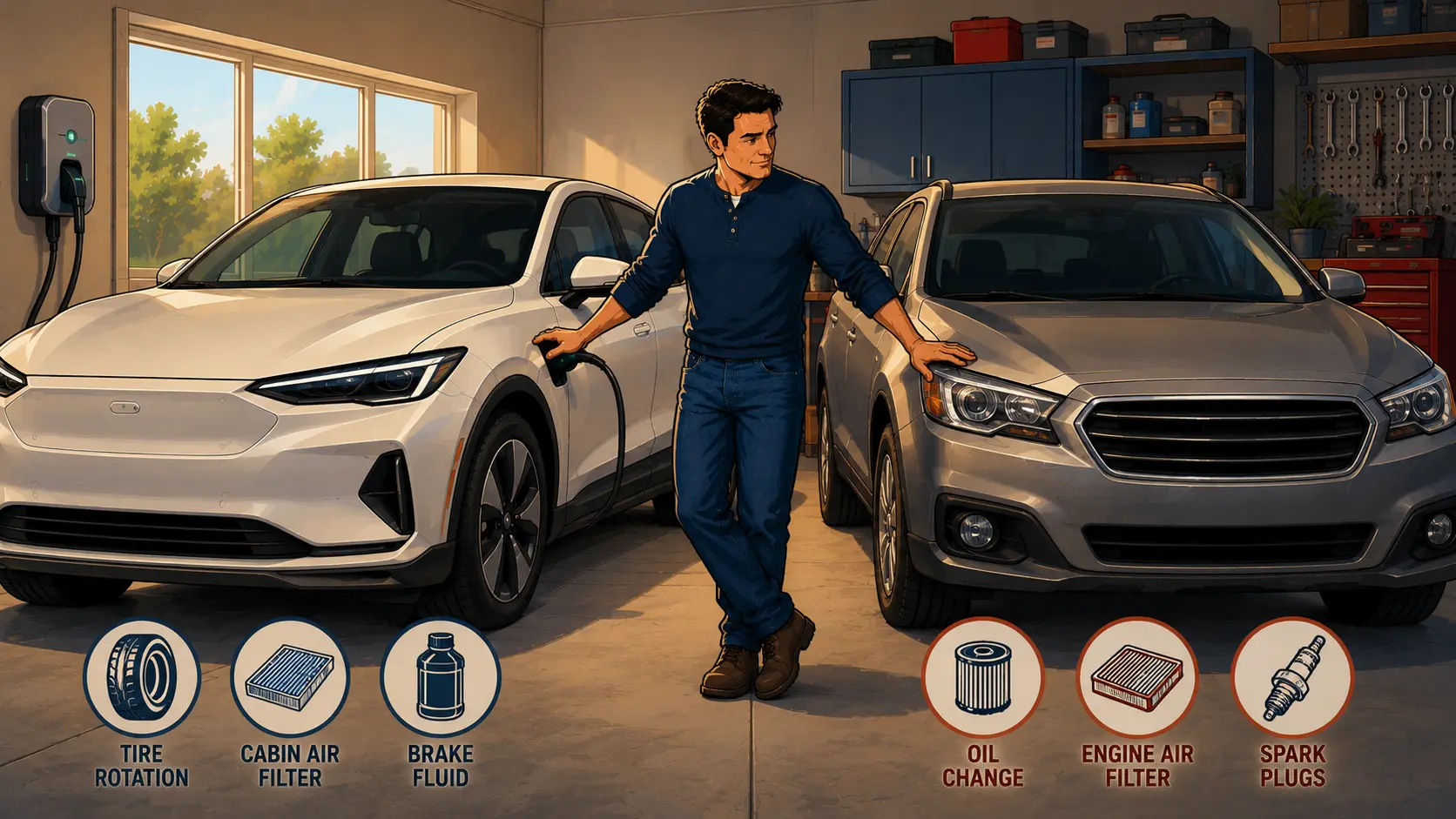
Electric vehicles skip oil changes, spark plugs, timing belts, fuel filters, and exhaust work, which cuts routine service costs by roughly 40 to 50 percent compared to gas cars. EVs still need tire rotations, brake fluid flushes, cabin air filters, wiper blades, 12V battery checks, and battery coolant service. Plan on tire replacements sooner because EVs are heavier and torque-rich, and a once-a-year inspection of the high voltage battery health, reduction gear fluid, and brake system.
Electric vehicles are no longer a niche curiosity. They sit in driveways next to gas sedans, share the same roads, and need the same kind of care to stay reliable. But the maintenance schedule is genuinely different, and the differences matter for your wallet, your time, and how long the car lasts.
This guide breaks down what EV maintenance vs gas car ownership really looks like in 2026. You will see what disappears, what stays the same, what is brand new, and how the cost-per-mile shakes out so you can make a smart call before your next service or your next purchase.
1. What Disappears When You Go Electric
The biggest reason EV maintenance costs less is the parts you simply never buy or service again. An electric motor has roughly 20 moving parts compared to about 2,000 in a modern gasoline engine, and that gap shows up on every service invoice.
Electric vehicles do not need oil changes, spark plugs, timing belts, fuel filters, exhaust repairs, or traditional transmission service. That removes five of the most common maintenance line items most gas car owners pay for every year.
Specifically, EV owners can cross these off the schedule:
- Engine oil and oil filter changes: No combustion engine, no oil to change. That saves around 60 to 100 dollars every six months for most drivers.
- Spark plugs and ignition coils: EVs have no spark ignition system at all.
- Timing belts and chains: Nothing to time when there are no valves to open and close.
- Fuel filters and fuel injectors: No liquid fuel system on a battery electric car.
- Exhaust systems, catalytic converters, and oxygen sensors: Nothing leaves the tailpipe, because there is no tailpipe.
- Engine air filter: No engine intake to filter.
- Traditional multi-speed transmission service: Most EVs use a single-speed reduction gear that needs fluid every 100,000 miles or so, not every 60,000.
If you are used to following a gas-car checklist like our car maintenance schedule by mileage, expect roughly half the line items to vanish on an EV. The other half look very familiar.
2. What Stays the Same on Both
EVs are still cars. They roll on tires, stop with friction brakes, carry passengers through dust and pollen, and wipe rain off the windshield. Those systems wear at roughly the same rate, and a few of them actually wear faster on an EV.
- Tires: Rotate every 5,000 to 7,500 miles and replace when tread reaches 4/32 inch. See our tire rotation guide for pattern details.
- Brake pads and rotors: Still need inspection, fluid flushes, and eventual replacement. Our DIY brake pad replacement guide applies to both fuel types.
- Cabin air filter: Same 15,000 to 30,000 mile interval. Walk through it in our cabin air filter replacement guide.
- Wiper blades: Replace every 6 to 12 months no matter what fuel sits under the hood.
- 12V auxiliary battery: Yes, EVs still have a small 12V battery for accessories. It needs the same care as a gas car battery.
- Suspension, steering, alignment: Identical service rhythm.
- Coolant: EVs use coolant too, just for the high voltage battery pack and motor electronics. More on that below.
3. New Things Only EV Owners Need to Watch
EVs come with their own short list of unique services. None of them are difficult, but skipping them can lead to expensive surprises.
High voltage battery coolant
Most modern EVs liquid-cool the traction battery. The coolant typically lasts 100,000 to 150,000 miles, but it is critical to use the exact OEM specification. Mixing the wrong fluid can damage the pack. Our general coolant types guide explains why fluid compatibility matters.
Reduction gear fluid
The single-speed gearbox between the motor and the wheels uses a small amount of gear oil. Most manufacturers list a 100,000 mile interval, though performance EVs and tow-rated trims may shorten it.
Brake fluid hygroscopic risk
Because regenerative braking does most of the slowing, EV brake pads barely wear, which is wonderful. The flip side is that brake fluid sits unused and absorbs moisture, lowering its boiling point and corroding internal parts. Most EV makers shorten the brake fluid flush interval to every 2 years or 25,000 miles regardless of pad wear.
12V auxiliary battery health
A dead 12V battery on an EV is the most common roadside issue. It powers door handles, computers, and the contactor that wakes the high voltage pack. If the 12V dies, you cannot even charge the main battery. Test it once a year with the steps in our car battery maintenance guide.
Battery state of health
Ask your service shop for an annual battery state of health report. It tells you what percentage of original capacity the pack still holds and flags weak cells before they become a warranty claim.
4. Where EVs Quietly Cost More
EVs are cheaper to maintain on average, but two line items push the other way and surprise new owners.
- Tires: A typical EV is 20 to 30 percent heavier than its gas equivalent, and instant torque accelerates wear. Expect to replace tires every 30,000 to 40,000 miles instead of 50,000 to 60,000. Sticky low-rolling-resistance EV tires also cost more per set.
- Out-of-warranty battery and motor work: Rare, but expensive. A pack replacement on a 5-year-old EV can run 8,000 to 20,000 dollars depending on the model, which is why the federal 8 year battery warranty matters.
Knowing your tire size and load rating helps you shop smart. Our tire sidewall numbers guide explains how to read the markings.
5. The Real Cost-Per-Mile Comparison
According to the U.S. Department of Energy, EV owners spend about 6 cents per mile on scheduled maintenance compared to roughly 10 cents per mile for a comparable gas vehicle. Over 100,000 miles that is a 4,000 dollar difference, before any fuel savings are counted.
Independent data from Consumer Reports car maintenance research and the federal fueleconomy.gov maintenance hub back up that range.
Where the savings come from:
- No oil changes over the life of the car: about 1,800 dollars saved over 100,000 miles
- No spark plugs, fuel filters, or exhaust repairs: 600 to 1,200 dollars saved
- Brake pads last 2 to 3 times longer thanks to regen: 400 to 800 dollars saved
- No emissions testing in many states (check your local rules)
Tires and the optional battery health check claw a little back, but EVs still finish ahead on routine service over any normal ownership horizon.
6. EV vs Gas Service Interval Snapshot
Here is a quick mental map of typical 2026-era intervals. Always confirm the exact numbers against your owner's manual.
Every 5,000 to 7,500 miles
- EV: tire rotation, multi-point inspection
- Gas: oil and filter, tire rotation, multi-point inspection
Every 15,000 to 30,000 miles
- EV: cabin air filter, wiper blades, software updates
- Gas: cabin air filter, engine air filter, wiper blades, fuel system inspection
Every 2 years or 25,000 miles
- EV: brake fluid flush, 12V battery test, battery state of health report
- Gas: brake fluid flush, battery test, transmission fluid check
Every 100,000 miles
- EV: reduction gear fluid, high voltage battery coolant
- Gas: spark plugs, timing belt (if equipped), transmission fluid change, coolant flush
7. Should Maintenance Costs Push You Toward an EV?
Maintenance alone is not a reason to switch, but it is a real number to add to your decision. Choosing an EV makes the strongest financial case when:
- You drive more than 10,000 miles per year
- You can charge at home overnight
- You plan to keep the car at least 5 years
- You live in a state with extra EV incentives or emissions inspection fees on gas cars
A gas car still wins when you tow heavy loads daily, drive long distances in regions without fast-charging infrastructure, or buy used and want a wide repair network. If you are weighing a used purchase either way, run through our used car pre-purchase mechanic's checklist before you sign anything.
Final Thoughts
EV maintenance is genuinely simpler than gas car maintenance, but it is not free. You trade oil changes and exhaust work for tire wear, battery fluid, and brake fluid hygiene. The net result is lower cost, fewer shop visits, and longer intervals between hassles.
The smartest move whether you drive electric or gas is to follow a written schedule, keep records, and address small issues before they grow. New EV owners should make a calendar reminder for the 12V battery test and brake fluid flush, because those are the two services that quietly bite when ignored.
Looking for more practical guides? Start with our complete car fluids guide, then bookmark our maintenance schedule by mileage. Both work for EVs once you skip the engine-only sections.
What to Read Next
Frequently Asked Questions: EV vs Gas Maintenance
Don't Miss Critical Car Care Tips
Get exclusive guides, money-saving maintenance tips, and early warning signs delivered straight to your inbox.