Wheel Alignment Cost and When You Actually Need One
Quick Answer
A wheel alignment usually costs $50 to $100 for a front-end (two wheel) alignment and $100 to $200 for a four-wheel alignment at US independent and chain shops. Dealers, luxury cars, lifted trucks, and cars that need their driver assist cameras recalibrated can run $200 to $400 or more. You need one after hitting a big pothole or curb, after replacing suspension or steering parts, or when the car pulls, the steering wheel sits crooked, or a tire wears on one edge.
The $100 Service Everyone Sells and Nobody Explains
Walk into almost any tire shop and someone will offer you an alignment. Sometimes you truly need it. Sometimes you are paying for a printout and a coffee. The trick is knowing which is which before you hand over your keys.
An alignment does not touch your tires. It adjusts the suspension so all four wheels point where the engineers intended. Get it wrong and a set of $800 tires can be bald on one edge in 10,000 miles. Get it right and they last the full tread life printed on the sidewall.
This guide gives you real prices, the six signs that genuinely mean "book it," the one symptom that almost never does, and a free 20 minute driveway check you can do before you spend a cent.
Tools for the Driveway Check
A gauge or two and a safe way to lift the car cover every check in this guide. Prices vary by country and seller.
tool
AstroAI / JACO Digital Tire Pressure Gauge
Lit LCD readout, plus or minus 1 percent accuracy, 0-150 PSI.
Check pricetool
Tire Tread Depth Gauge (32nds and mm)
Exact tread readings in 32nds or millimetres. Pocket sized, under $12.
Check pricetool
3 Ton Ratcheting Jack Stands (Pair)
ASME-certified double-locking stands. Never work under a jack alone.
Check priceAffiliate links. We may earn a small commission at no extra cost to you. Learn more.
A wheel alignment adjusts three angles on each wheel so the tires meet the road flat and roll dead straight. When those angles drift, the car still drives. It just quietly scrubs rubber off your tires with every mile, and makes the steering work harder than it should.
Angles drift for boring reasons. Potholes. Curbs. Worn rubber bushings. A new tie rod that was fitted a few turns off. Even a set of lowering springs. None of these announce themselves loudly, which is why the tires usually tell the story first.
Fix it and you get three wins: longer tire life, slightly better fuel economy from less rolling drag, and a car that tracks straight without you fighting the wheel on the highway. The federal safety agency's tire safety guidance lists alignment alongside pressure and rotation as core tire care for exactly that reason.
How Much Does a Wheel Alignment Cost?
Prices swing more than most people expect, mainly because of the type of alignment, the kind of shop, and your car. Here is what US drivers typically pay in 2026.
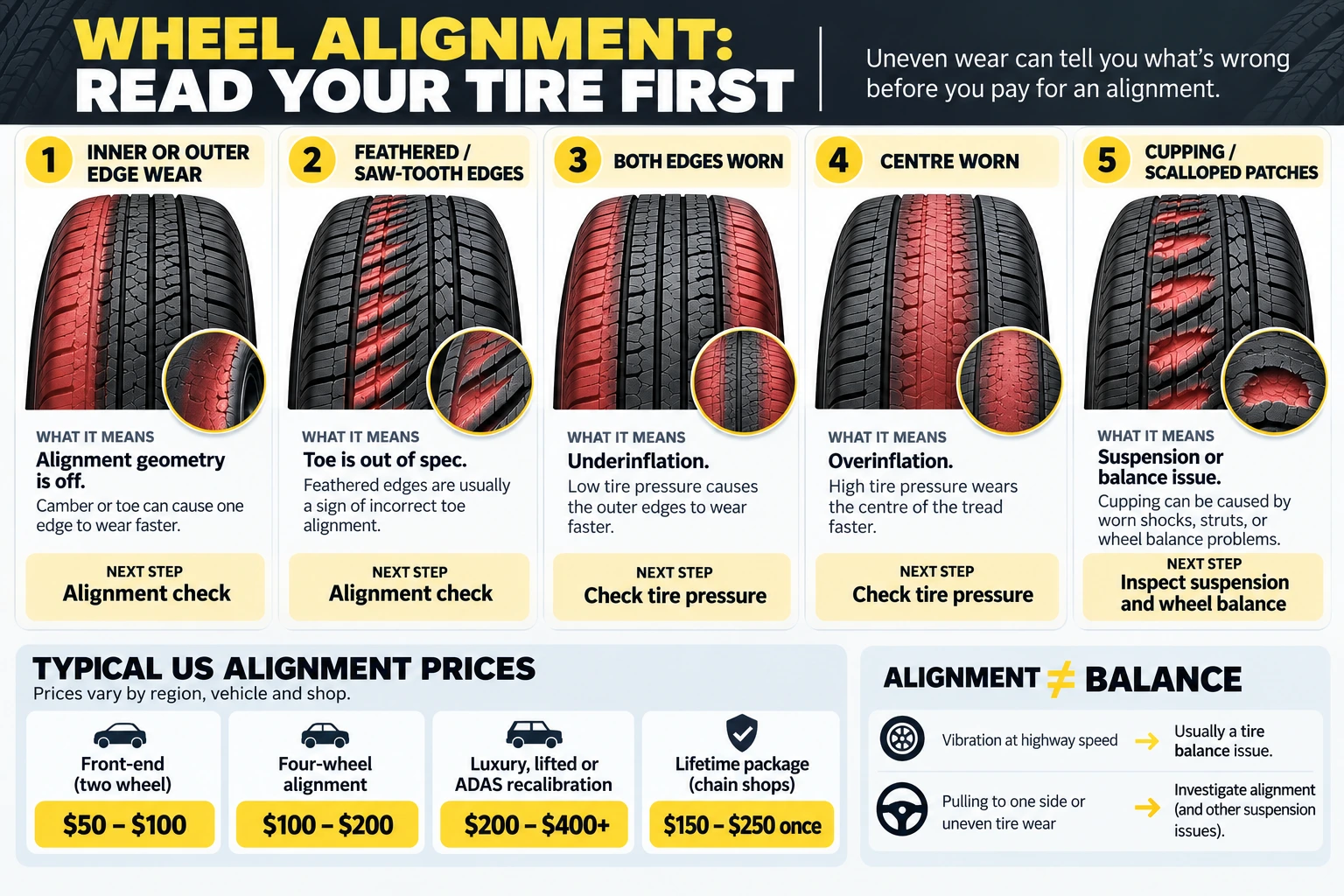
Front-end (two wheel) alignment: $50 to $100
Only the front wheels are adjusted. Fine for many older cars with a solid rear axle that has no adjustment anyway.
Four-wheel alignment: $100 to $200
All four wheels are measured and adjusted. Most modern cars with independent rear suspension need this, and many shops only sell this option.
Dealer or luxury model: $150 to $250
Same machine, higher labor rate. European brands and cars with special adjustment tools sit here.
Driver assist recalibration: add $100 to $300
If your car has lane keeping or adaptive cruise, some makers require the forward camera to be recalibrated after an alignment. Ask before you book.
Lifetime package: $150 to $250 once
Unlimited alignments at one chain for as long as you own the car. Worth it only if you keep the car and remember to use it.
Hidden extras that raise the bill
- Seized adjusters: rusty cam bolts or tie rod sleeves can add $30 to $100 in labor.
- Worn parts: a shop cannot align a car with loose tie rods or ball joints. Expect a quote for those first.
- Camber kits: lowered or lifted cars may need aftermarket bolts or arms, from $50 to $300.
- Truck and SUV surcharge: large 4x4s often cost $20 to $50 more.
DIY Check vs Shop Alignment: The Real Cost
DIY Driveway Check
- Tire pressure and tread gauges: $10 to $30 once
- Tape measure and chalk: already in the drawer
- Time: about 20 minutes
- Result: you know whether you truly need to pay
At the Shop
- Four-wheel alignment: $100 to $200
- Alignment check only: free to $50 at many shops
- Time: about an hour on the machine
- Result: precise adjustment to factory specs
The smart play is a hybrid. Do the free checks at home, fix the cheap stuff yourself, and only pay a shop for the part that genuinely needs a laser rig. If you like that approach, our guide on saving money on car repairs applies it to dozens of other jobs.
Six Signs You Actually Need an Alignment
1. The car pulls to one side
On a flat, straight road, you have to hold the wheel slightly left or right to keep going straight. Rule out a low tire first.
2. The steering wheel sits crooked
The car goes straight but the logo on the wheel is tilted. This is the clearest toe symptom there is.
3. One tire edge is wearing fast
Bald on the inside shoulder, fine on the outside. That is camber or toe eating your tire. Our tire tread depth guide shows how to measure it properly.
4. Tires squeal on easy corners
Squealing at parking lot speeds means the tires are being dragged sideways instead of rolling.
5. You just hit something hard
A deep pothole or a curb strike can bend a tie rod or knock the toe out in one hit.
6. You replaced suspension or steering parts
New struts, control arms, or tie rods always change the geometry. Alignment after that work is not optional.
When You Do NOT Need an Alignment
This is where most upsells happen. A shaking steering wheel at highway speed is almost always a balance problem, not alignment. Balancing costs $15 to $25 per wheel and fixes a wobble that an alignment will never touch.
Clunks over bumps, a floaty ride, or a wandering feel are usually worn parts. Our suspension problems guide and car noises guide help you pin those down first. Humming that rises with speed often points to a failing wheel bearing, not alignment.
Fix worn parts before you align
Camber, Caster and Toe, Explained Simply
- Camber is how much the top of the tire leans in or out when you look from the front. Too much lean wears one edge.
- Toe is whether the fronts of the tires point toward each other or apart, like your feet. It is the biggest tire killer and the most common adjustment.
- Caster is the tilt of the steering axis seen from the side. It helps the wheel return to center after a turn. It rarely wears tires, but uneven caster makes the car pull.
Tire makers such as Bridgestone's learning center publish wear pattern charts that line up with these three angles, which is why reading your tread is such a useful first step.
Free 20 Minute Driveway Check in 7 Steps
Run through these before you book. You will either save the money or walk into the shop knowing exactly what to ask for.
Set the tire pressure
Inflate all four tires to the pressure on the door jamb sticker, not the number on the sidewall. A tire just 6 psi low can make a car pull. Our tire pressure guide covers doing it cold for an accurate reading.
Read the tread wear pattern
Turn the steering to full lock so you can see across each front tire. One-edge wear points to camber. Feathered edges that feel smooth one way and rough the other point to toe. Both edges or the center point to pressure.
Do a straight road test
On a flat, empty road at 30 to 40 mph, loosen your grip. A gentle drift right can be normal road crown. A firm, steady pull, or a pull that stays the same on a different road, is a real problem.
Check the steering wheel center
While driving straight, glance at the wheel. If the logo tilts more than a few degrees, the toe is out, even if the car does not pull.
Bounce test the suspension
Push down hard on each corner and let go. One rebound and settle is healthy. Two or more means tired shocks or struts. Our shocks vs struts guide explains what you are dealing with.
Look for worn steering parts
With the front safely on jack stands, grab each tire at 9 and 3 o'clock and rock it. Clunks or play usually mean tie rod ends. Then grab at 12 and 6 o'clock: play there points to ball joints or a wheel bearing.
Do a rough toe check
Chalk a mark at the center of the tread on the front of both front tires, at hub height, and measure between them. Roll the car forward half a turn so the marks sit at the back, and measure again. A difference over about 1/8 inch means book a proper alignment.
Pair it with a rotation
How to Avoid Being Upsold at the Shop
- Ask for the before and after printout. Every alignment machine produces one. Red numbers should turn green.
- Ask which angles were out. If everything was already in spec, you should not pay for an adjustment.
- Ask for a free alignment check first. Many chains offer one, and it tells you if the full service is needed.
- Question parts quotes. Ask to see the play in a tie rod or ball joint before approving it.
- Confirm driver assist costs upfront if your car has lane keeping cameras.
The Bottom Line
Expect to pay $100 to $200 for a four-wheel alignment in most of the US, and treat anything much higher as a reason to ask questions. Book one after a hard hit, after suspension or steering work, or when your tires start telling you something is off.
But check first. Set the pressure, read the tread, and feel how the car drives. Twenty minutes in the driveway is the difference between paying for what you need and paying for a printout.
What to Read Next
How to Identify Suspension Problems
Rule out worn parts before paying for an alignment
How to Rotate Your Tires
The cheap habit that keeps wear even between alignments
How to Check Tire Tread Depth
Measure uneven wear and know when tires are done
Tire Pressure Guide
The first thing to check when a car pulls
Frequently Asked Questions
Don't Miss Critical Car Care Tips
Get exclusive guides, money-saving maintenance tips, and early warning signs delivered straight to your inbox.