P0420 Code: Catalytic Converter Causes and Fixes
Quick Answer
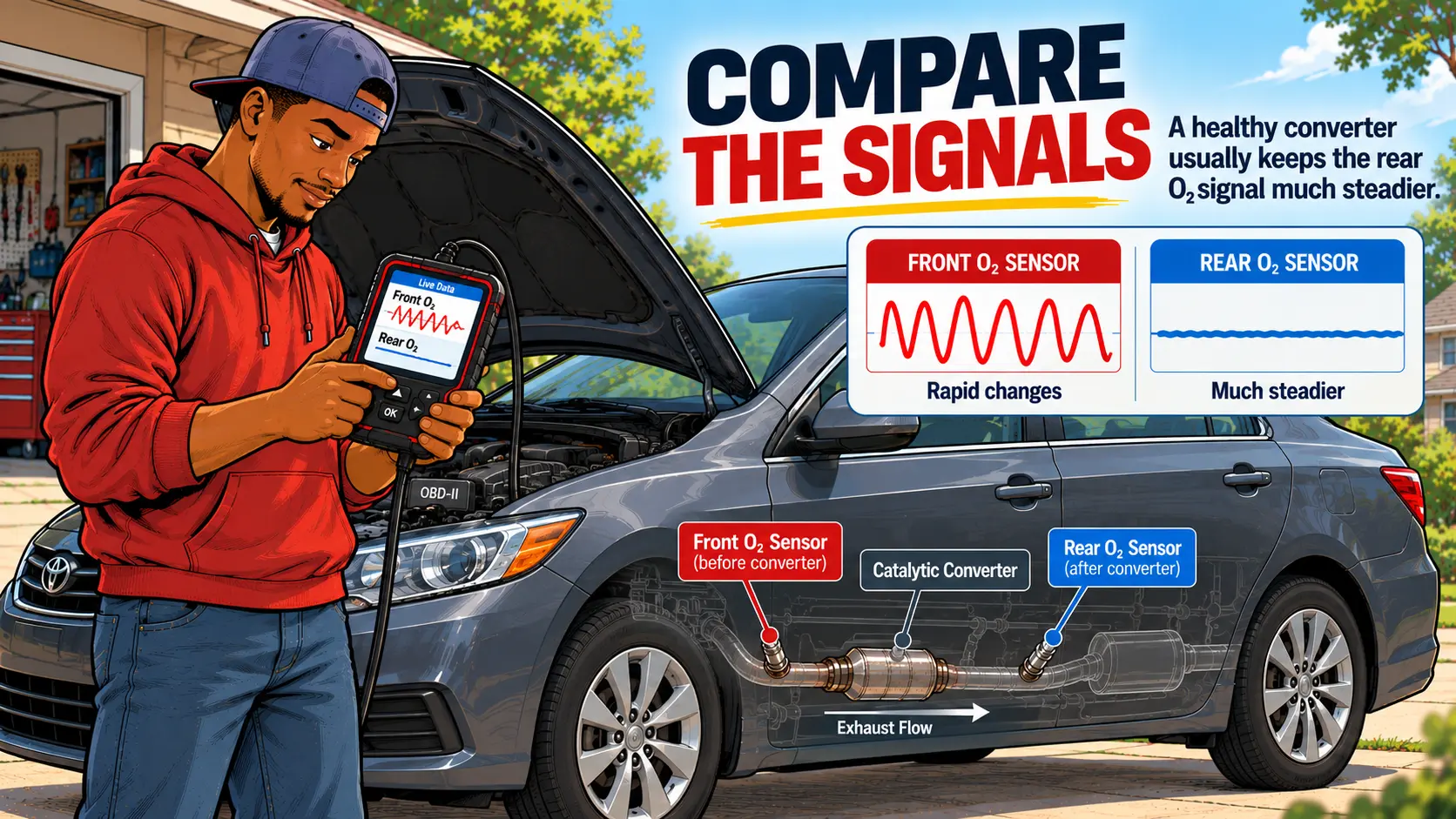
P0420 means catalyst system efficiency below threshold, bank 1. Your car compares the oxygen sensor before the catalytic converter with the one after it. When those two signals start to look alike, the computer decides the converter is no longer cleaning the exhaust well enough and sets the code. A failing converter is only one possible cause. Exhaust leaks, a lazy downstream oxygen sensor, misfires, and burning oil all trigger the same code. The car is usually safe to drive in the short term, but it will fail an emissions test and the underlying fault can destroy an expensive converter if you ignore it.
The Most Expensive Code You Should Not Panic About
P0420 is the most searched trouble code in America, and there is a good reason for that. Plug in a scanner, read the code, search it online, and within about thirty seconds someone tells you the catalytic converter is dead and the repair runs into four figures. That is the story most shops lead with too, because replacing the converter is the fix that always works.
Here is the part nobody tells you first. P0420 is a monitoring result, not a component failure. It reports that the exhaust leaving your converter looks too much like the exhaust going in. Plenty of cheap faults produce that exact reading with a perfectly healthy converter sitting in the pipe.
This guide walks the diagnosis in cost order, from a two dollar gas cap check to the converter itself, so you spend money in the right sequence instead of the expensive one.
Tools You Will Need for This Diagnosis
You cannot diagnose P0420 with a basic code reader. Live oxygen sensor data is the whole job.
tool
OBD2 Scanner
Read and clear check engine codes in seconds.
Check pricetool
Bidirectional Scan Tool (Autel / Launch style)
Pro-grade: bidirectional tests, oil resets, service modes. $200 to $500.
Check pricetool
Craftsman 450-Piece Mechanics Tool Set
Huge coverage per dollar with a lifetime warranty behind it.
Check priceAffiliate links. We may earn a small commission at no extra cost to you. Learn more.
Your engine computer does not measure how clean your exhaust is. It compares. One oxygen sensor sits ahead of the catalytic converter and one sits behind it. The front sensor swings up and down constantly as the fuel mixture shifts. The rear sensor should sit almost still, because a healthy converter buffers oxygen and smooths everything out.
When the rear sensor starts copying the front sensor's swings, the computer concludes the converter has lost efficiency and stores P0420: catalyst system efficiency below threshold, bank 1. Bank 1 simply means the side of the engine with cylinder number one. On a four cylinder engine there is only one bank.
That is the whole test. It is an inference, not a measurement of the converter itself, which is exactly why so many people replace a converter and watch the light come straight back on.
Cheap Causes to Rule Out First
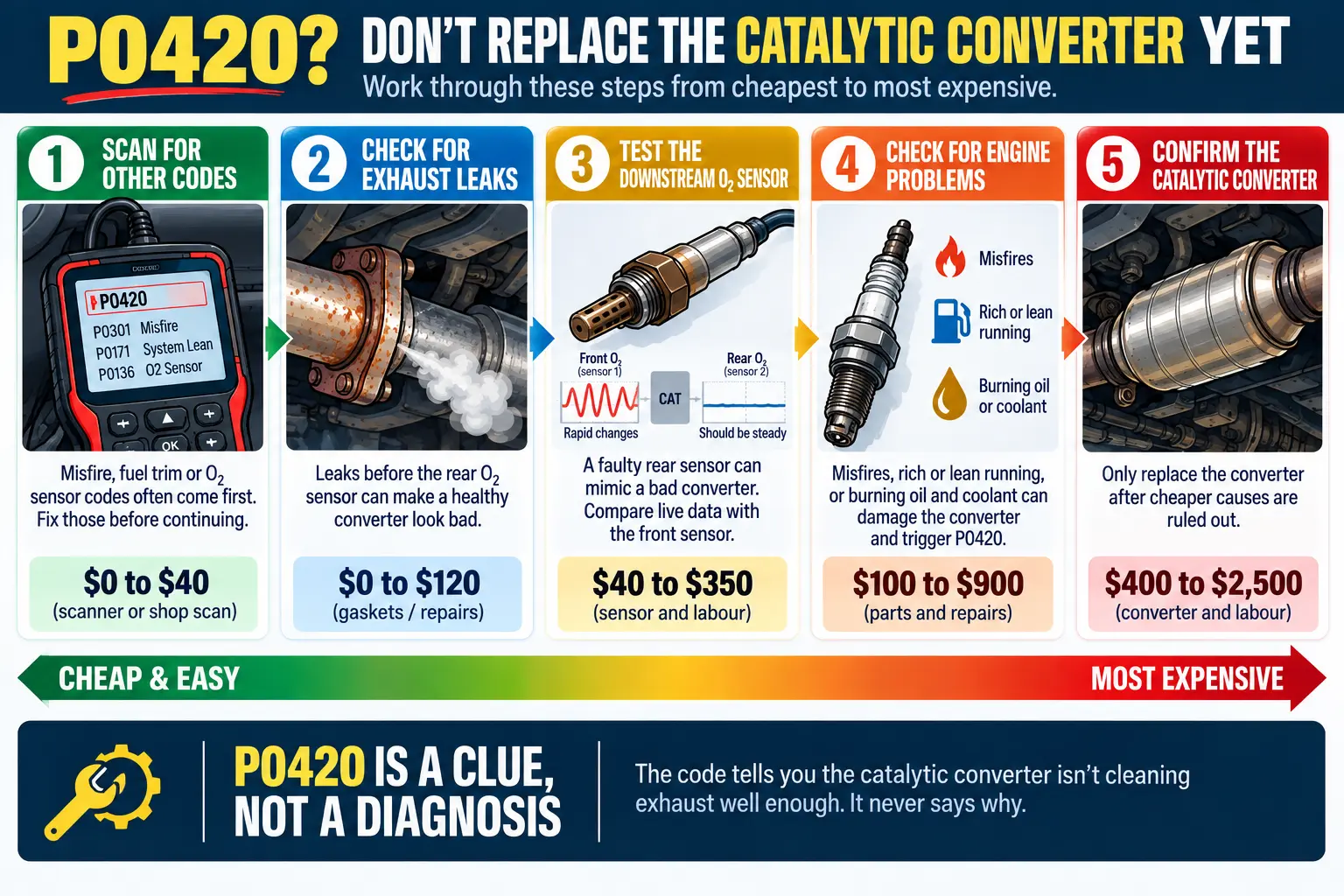
Every one of these can produce P0420 with a perfectly good converter in the pipe. Work through them before you price a replacement.
A loose, cracked, or aftermarket gas cap
A cap that no longer seals upsets the evaporative and fuel trim system, which changes the mixture reaching the converter. It is a two minute check and the cheapest thing on this list.
An exhaust leak ahead of the rear sensor
A pinhole in a weld, a rusted flange, or a failed gasket lets fresh air into the pipe. That extra oxygen reaches the downstream sensor and makes a working converter look like a dead one. Listen with the engine cold, when leaks tick loudest.
A misfire you may not even feel
Unburnt fuel from a weak coil or worn spark plug goes straight into the converter and burns there. That both skews the reading and slowly destroys the converter. Our spark plug replacement guide covers the fix.
A rich or lean running condition
A dirty mass airflow sensor, a vacuum leak, or a tired fuel injector shifts the mixture far enough that the converter cannot keep up. Fix the mixture and efficiency often returns.
Burning oil or coolant
Oil and coolant coat the precious metals inside the converter and poison them permanently. If your engine drinks either, fix that first or the new converter will fail as well. Check your levels with the car fluids guide.
A cheap aftermarket converter fitted previously
Budget universal converters often carry less catalyst material than the original. They frequently trigger P0420 within months even though they are brand new, especially on cars built for California emissions standards.
CHECK EVERY CODE, NOT JUST P0420
P0420 rarely arrives alone when something else is wrong. Misfire codes in the P0300 range, oxygen sensor codes in the P0130 to P0167 range, and fuel trim codes P0171 or P0172 all point at the real fault. Fix those first, clear the memory, and drive a full cycle before deciding P0420 is still a problem. Our check engine light diagnosis guide walks through reading a full code set properly.
How to Diagnose P0420: Step by Step
Budget about ninety minutes for the first pass, plus a week of normal driving to confirm the fix. You need an OBD2 scanner that shows live data, not just a code reader.
Pull Every Code and the Freeze Frame
Plug the scanner into the port under the driver's side dash with the ignition on. Record every stored and pending code, then open the freeze frame data, which captures engine speed, load, coolant temperature, and fuel trims at the exact moment P0420 set. Those numbers tell you whether the code appeared at idle, on the highway, or during a cold start. Our OBD2 scanner guide explains every menu on a typical tool.
Check the Gas Cap and Hunt for Exhaust Leaks
Remove the cap, inspect the rubber seal for cracks and flat spots, then refit it until it clicks. Next, start the engine cold and listen from the manifold back along the pipe to the rear oxygen sensor. A ticking that fades as the metal expands is a leak. Feel for puffs of air with the back of your hand, keeping clear of hot surfaces.
Repair Any Other Codes First
Misfires, fuel trim faults, and upstream oxygen sensor problems all cause P0420 and all damage converters. Fix them, clear the codes, then drive normally for a week before rescanning. A surprising number of P0420 cases simply do not return after this step.
Watch Both Oxygen Sensors in Live Data
Warm the engine fully, then display sensor 1 and sensor 2 voltages side by side. Hold about 2,500 rpm. The upstream sensor should oscillate rapidly between roughly 0.1 and 0.9 volts. The downstream sensor should hover near 0.6 to 0.7 volts with only lazy movement. If the rear trace mirrors the front, either the converter has lost its oxygen storage or that sensor is faulty.
Test the Downstream Sensor Before Condemning the Cat
Snap the throttle and watch how quickly the rear sensor reacts. A sensor that responds sluggishly, sits stuck at one voltage, or shows soot and oil fouling on its tip is suspect. Inspect the connector and wiring for heat damage and corrosion. Replacing a genuinely lazy sensor is a fraction of converter money.
Assess the Converter Itself
With the car safely supported, tap the converter body with a rubber mallet and listen for rattling, which means the internal honeycomb has broken up. Look for a casing that has discoloured or bulged from overheating. If you have an infrared thermometer, a healthy converter usually runs at least 100 degrees Fahrenheit hotter at the outlet than the inlet once warmed up. Read our jack and jack stand guide before going under any vehicle.
Clear the Code and Complete a Drive Cycle
After each repair, clear the codes and drive normally. The catalyst monitor needs a cold start, a full warm-up, and steady cruising to run again, which usually takes between 50 and 200 miles. Rescan afterwards and confirm the catalyst monitor shows ready with no returning code. Only then is the job finished.
Upstream vs Downstream: What Each Sensor Tells You
Understanding the two sensors is the difference between diagnosing P0420 and guessing at it.
Upstream sensor (sensor 1)
Sits before the converter and controls fuel delivery. Its voltage should swing fast and wide as the computer trims the mixture. A flat or slow upstream sensor sets its own code and ruins fuel economy.
Downstream sensor (sensor 2)
Sits after the converter and only watches efficiency. A steady, calm trace means the converter is storing and releasing oxygen correctly. A trace that copies the upstream sensor is what triggers P0420.
The federal On-Board Diagnostics programme, described by the EPA's transportation and emissions resources, exists precisely so this monitoring runs continuously rather than only at inspection time. That is why the code appears long before you would notice anything wrong from the driver's seat.
Catalytic Converter Symptoms Worth Knowing
A converter that has genuinely failed usually gives you more than a code. Look for these alongside P0420, because together they build a much stronger case.
- Rotten egg or sulphur smell: unburnt sulphur compounds passing straight through instead of being converted.
- Rattling from under the floor: the ceramic honeycomb inside has broken apart and is loose in the casing.
- Sluggish acceleration that worsens with heat: a partially blocked converter chokes exhaust flow, and the restriction grows as parts expand.
- Worse fuel economy for no other reason: the engine works harder to push exhaust past the restriction.
- Excess heat under the car: a converter casing that glows or scorches the heat shield is failing badly.
- A failed emissions test with high hydrocarbon readings: hard evidence the converter is no longer doing its job.
Notice what is missing. A converter can set P0420 while the car drives perfectly. Efficiency falls gradually, and the computer notices the change long before your right foot does. Persistent overheating is worth ruling out too, since it cooks converters over time. Our overheating guide covers the usual suspects.
What the Repair Actually Costs
Doing It Yourself
- Gas cap: $12 to $30
- OBD2 scanner with live data: $40 to $150, reusable forever
- Downstream oxygen sensor: $40 to $150 for the part
- Spark plugs and a coil: $60 to $200
- Aftermarket converter, common car: $150 to $600 for the part
- Time: two to four hours for most jobs
At the Shop
- Diagnostic fee: $75 to $180
- Exhaust leak repair: $100 to $400
- Oxygen sensor replacement: $150 to $400 fitted
- Misfire repair: $200 to $700
- Converter replacement: $900 to $2,500 fitted
- Hybrids, trucks, and European models sit at the top of that range
The gap between a $30 gas cap and a $2,000 converter is the entire reason to diagnose in order. Even if you end up needing the converter, everything you checked first either ruled out a cheaper fault or fixed the thing that would have killed the new part. If money is tight, our guide on saving money on car repairs covers getting fair quotes.
DO NOT USE AN O2 SENSOR SPACER
Spacers and non-fouler adapters move the rear sensor out of the exhaust stream so it stops reporting the fault. That is tampering with federally required emissions equipment, it is illegal in the United States, and it will fail an inspection in any state with a visual check. It also blinds the one system that would warn you when something genuinely goes wrong downstream. Diagnose the fault, or budget for the repair.
Codes That Travel With P0420
- P0430: the identical fault on bank 2, the other side of a V6 or V8 engine. Both codes at once usually points at a shared cause such as a fuel trim or sensor problem rather than two dead converters.
- P0300 to P0308: random or cylinder specific misfires. Always fix these first.
- P0171 and P0174: the system running lean, often from a vacuum leak or dirty mass airflow sensor.
- P0136 and P0141: downstream oxygen sensor circuit and heater faults, strong evidence the sensor rather than the converter is at fault.
If you are new to reading codes at all, start with our dashboard warning lights guide and then move on to the best OBD2 scanners for 2026 if you still need a tool.
The Bottom Line
P0420 is a report card, not a death certificate. The computer is telling you the exhaust leaving the converter looks too much like the exhaust going in, and there are at least six reasons that can happen with a healthy converter installed. Check the gas cap, hunt for leaks, fix every other code, study the oxygen sensor traces, and only then talk about a converter.
Do it in that order and one of two things happens. Either you find a cheap fault and save yourself four figures, or you confirm the converter really is finished and fit the new one knowing it will last.
What to Read Next
Frequently Asked Questions
Don't Miss Critical Car Care Tips
Get exclusive guides, money-saving maintenance tips, and early warning signs delivered straight to your inbox.