How to Check Your Transmission Fluid (and What the Color Means)
Quick Answer
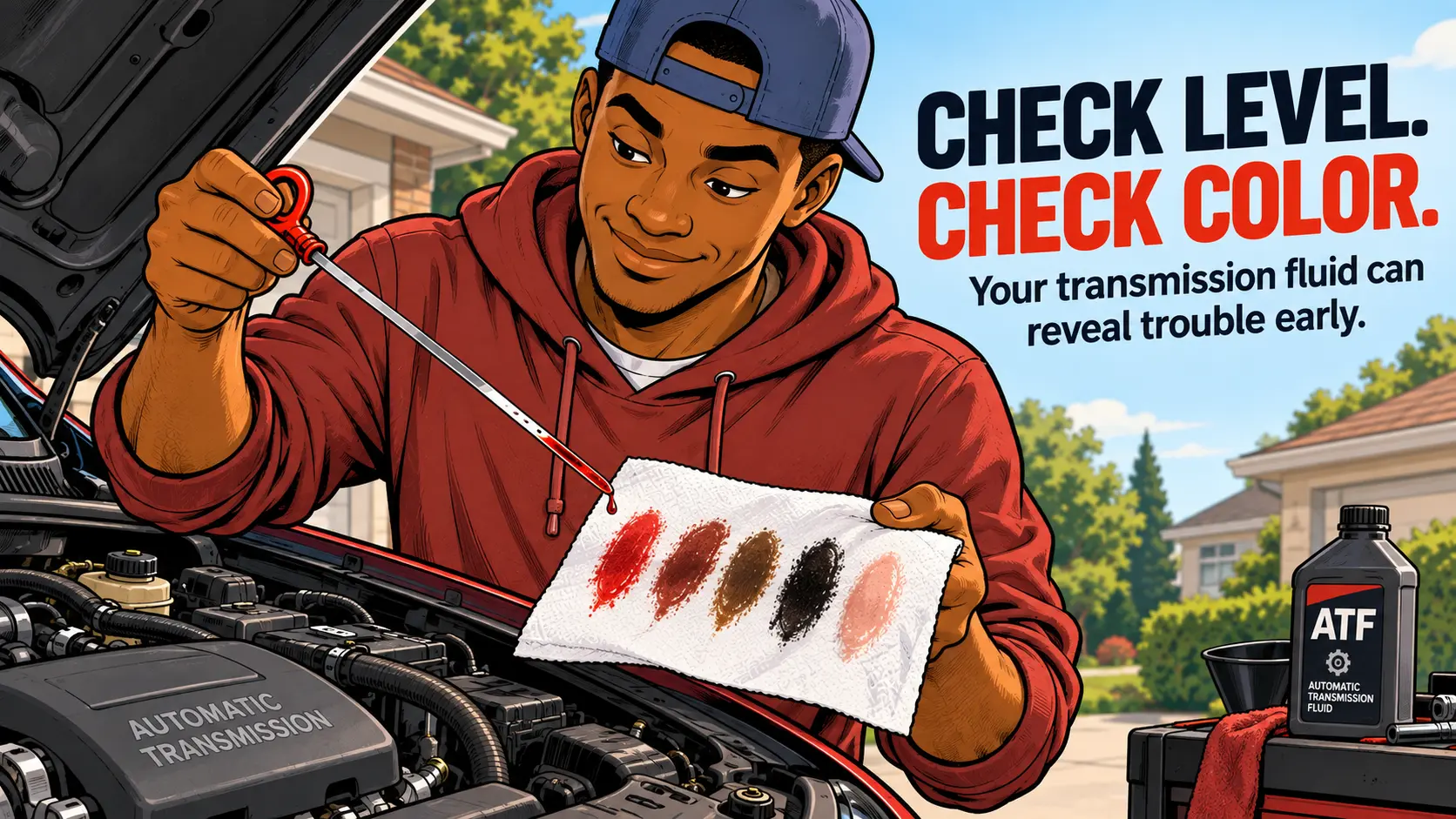
Park on level ground, drive for about 10 minutes to warm the fluid, then leave the engine idling in Park with the handbrake on. Pull the transmission dipstick, wipe it with a clean rag, push it fully back in and pull it again. The fluid should sit between the two HOT marks and look translucent red or light brown with no burnt smell. Dark brown, black, milky or burnt fluid means service is due. If your car has no dipstick, the transmission is sealed and the level must be checked from underneath at a set fluid temperature.
Ten Minutes Now Beats a $4,000 Rebuild Later
Transmission fluid is the only thing standing between your gearbox and a very expensive Saturday. It lubricates, it cools, and in an automatic it is the hydraulic muscle that actually moves the gears. Let the level drop or let the fluid cook, and the damage builds quietly until the day the car refuses to pull away.
Here is the frustrating part. Most drivers never check it. Engine oil gets the attention because the dipstick is obvious and the sticker on the windshield nags you. Transmission fluid sits a few inches away, costs a fraction of a rebuild to top up, and gets ignored until the shifts turn ugly.
This guide walks through the check on dipstick cars, explains what to do on the growing number of sealed transmissions that have no dipstick at all, and gives you a plain-English color chart so you can read the fluid like a mechanic does.
Grab a clean rag. This takes ten minutes and tells you more about your car's health than almost any other check you can do in a driveway.
Tools You Will Need for This Check
A rag, a funnel, and the right fluid. That is the whole shopping list for a driveway transmission fluid check.
fluid
Valvoline MaxLife Multi-Vehicle ATF
Covers most Dexron, Mercon, and import specs in one bottle.
Check pricetool
Manual Fluid Transfer Pump
For clean ATF top-ups and fills.
Check pricetool
15-Quart Oil/Coolant Drain Pan
Wide-mouth, sealable for clean disposal.
Check priceAffiliate links. We may earn a small commission at no extra cost to you. Learn more.
An automatic transmission is a hydraulic machine. The fluid inside it does four jobs at once: it lubricates hundreds of moving parts, it carries heat away to the cooler, it keeps the clutch packs and seals conditioned, and it acts as the pressurised medium that actually engages the gears. Engine oil only has to lubricate. Transmission fluid has to work.
That is why the condition of the fluid tells you so much. Heat is the enemy of a transmission, and heat leaves a signature in the fluid you can see and smell in seconds. Checking it costs nothing and catches trouble months before the car starts misbehaving.
Before You Start: Does Your Car Even Have a Dipstick?
This is the first fork in the road, and most guides skip it. Vehicles fall into two camps:
- Dipstick transmissions: Common on most vehicles built before roughly 2010, and still used by plenty of trucks and older designs. You can check the level and condition in your driveway in ten minutes.
- Sealed transmissions: Increasingly standard on modern cars. There is no dipstick and no filler tube under the hood. The level is set through a check plug on the side of the transmission case, with the fluid held in a narrow temperature window. That is a lift-and-scan-tool job, not a driveway one.
Pop the hood and look for a dipstick handle, usually red or yellow, set back from the engine oil dipstick. On front-wheel-drive cars it tends to sit near the front or side of the transmission housing, close to the firewall. On rear-wheel-drive vehicles it is usually further back, toward the transmission tunnel. If there is nothing there, your transmission is sealed. Skip ahead to the sealed transmission section below.
CHECK THE DIPSTICK ITSELF
Many manufacturers stamp the correct procedure directly onto the dipstick: engine running or off, in Park or Neutral, hot or cold. Read it before you do anything else. It overrides any general advice, including ours.
How to Check Transmission Fluid: Step by Step
The whole process takes about ten minutes, including the warm-up drive. Wear gloves. Warm transmission fluid stains and it is stubborn stuff to get off skin.
Park on Level Ground
A slope tilts the fluid in the pan and throws the reading off by a surprising margin. Flat driveway, flat garage floor, or a level stretch of road. Set the parking brake before you do anything else.
Warm the Fluid Up
Drive for about 10 minutes, or let the engine idle until it reaches normal operating temperature. Transmission fluid expands as it heats, so a cold check reads low and can trick you into overfilling. Most dipsticks have separate COLD and HOT ranges for exactly this reason.
Leave It Running in Park
For most automatics, the engine stays running with the selector in Park or Neutral. The pump needs to be circulating fluid for the level in the pan to be accurate. Some models, notably several Honda and Chrysler designs, call for the engine off. Confirm before you read.
Pull the Dipstick and Wipe It Clean
Pull it straight out and wipe it down with a clean lint-free rag or paper towel. Fluid splashes around inside the tube while you drive, so the first pull is never a reliable reading.
Reinsert Fully, Then Pull Again
Push the dipstick all the way back down until it seats, wait a second, then pull it out again. This second reading is the real one. Hold it horizontally so the fluid does not run along the stick and blur the line.
Read the Level
With the engine warm, the fluid should sit between the two marks in the HOT or FULL HOT range. Right at the top of the range is fine. Below the lower mark means you are low and something is leaking. Above the top mark means overfilled, which causes its own problems.
Judge the Color and Smell
Wipe a smear of the fluid onto a white paper towel. The white background is what makes the color obvious. Then smell it. Clean fluid smells faintly sweet and slightly petroleum-like. Burnt fluid smells like scorched toast and you will know it immediately.
What the Color of Your Transmission Fluid Means
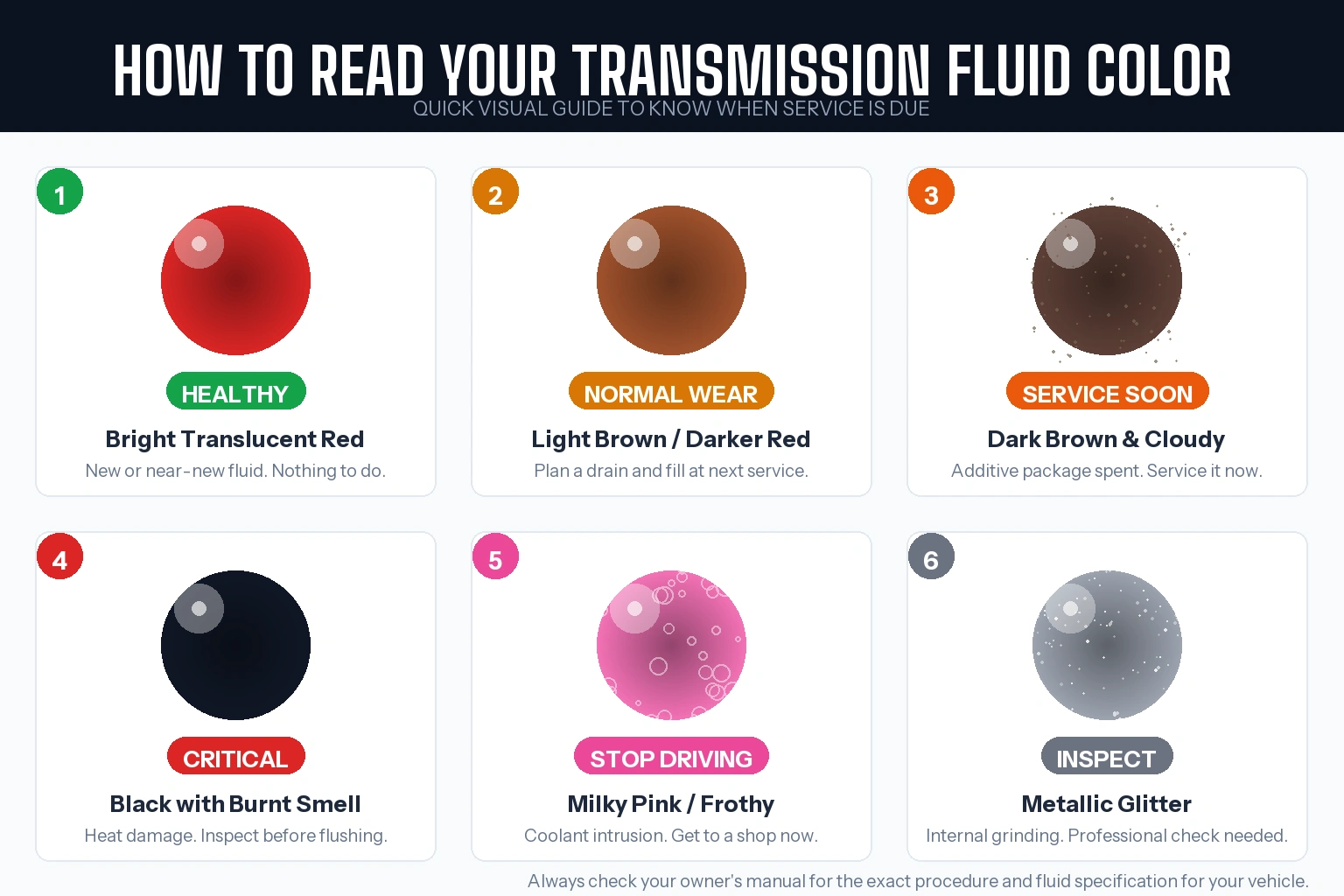
This is the part that turns a level check into a diagnosis. Smear the fluid on a white paper towel and match it against the list below.
Bright translucent red: healthy
This is new or near-new fluid. It should look clear enough to see the paper towel through it. Nothing to do. Recheck at your next oil change.
Light brown or darker red, still translucent: normal wear
Fluid darkens with heat cycles. This is the expected look at mid-service-life. No panic, but note the mileage and plan a drain and fill within the next service window.
Dark brown and cloudy: overdue
The additive package is spent and the fluid is carrying suspended clutch material. Service it now. A drain and fill at this stage is cheap insurance against the next stage.
Black with a burnt smell: heat damage
Clutch material has been cooking. This is not just old fluid, it is evidence of internal wear. Get the transmission inspected before you decide on a flush, because on a badly worn unit a flush can dislodge debris and make shifting worse.
Milky pink or frothy strawberry-milkshake: coolant intrusion
Coolant has crossed into the transmission, almost always through a failed cooler inside the radiator. This destroys clutch packs fast. Stop driving it and get it to a shop.
Metallic glitter in the fluid
Fine metal particles catching the light mean internal components are grinding. A professional inspection is the only sensible next step.
BURNT OR MILKY FLUID IS NOT A DIY FIX
Dark burnt fluid and coolant-contaminated fluid both point to internal damage that a fluid change alone will not solve. Have a transmission specialist inspect the unit before spending money on a flush. Replacing fluid on a transmission that is already slipping can occasionally accelerate the failure.
Symptoms of Low Transmission Fluid
A transmission is a closed hydraulic system. It should not consume fluid the way an engine burns a little oil. If the level is low, fluid is escaping somewhere. These are the symptoms drivers notice first:
- Delayed engagement: You shift into Drive and the car takes a full second or more to respond. This is usually the earliest warning.
- Slipping: The engine revs climb but the car does not accelerate to match. Covered in depth in our transmission slipping symptoms guide.
- Harsh or clunky shifts: Gear changes that used to be seamless now thump.
- Whining or humming that changes with speed: Often the pump struggling to pick up fluid.
- Overheating on hills or while towing: Less fluid means less capacity to carry heat away.
- Red spots on the driveway: Transmission fluid is red and thinner than engine oil. Our car fluids guide helps you identify what is leaking by color and location.
How to Top Up Transmission Fluid Safely
If the level is low and the fluid still looks healthy, topping up is straightforward on a dipstick car:
- Buy the exact specification your manufacturer lists. This is not a place to improvise. Dexron, Mercon, ATF+4, CVT fluid and the various factory-specific fluids are not interchangeable. Using the wrong one can wreck a transmission in a few thousand miles. Our ATF buyer's guide for 2026 breaks down which spec suits which vehicle.
- Add through the dipstick tube using a long-neck funnel. That tube is the filler on almost every dipstick-equipped automatic.
- Add small amounts, about a quarter of a bottle at a time, then recheck with the engine running and warm. The gap between the two dipstick marks is often less than half a litre, so it fills faster than you expect.
- Stop at the top of the HOT range. Do not chase the very top of the stick.
DO NOT OVERFILL
Too much fluid gets whipped into foam by the spinning gearsets. Foam cannot carry hydraulic pressure, so you get slipping, erratic shifting, and rising temperatures. If you overshoot, the excess has to be drained out. Add slowly and recheck often.
Sealed Transmissions: What to Do When There Is No Dipstick
Manufacturers moved to sealed units to cut warranty claims from people adding the wrong fluid or the wrong amount. The fluid is still not permanent, whatever "lifetime fill" implies. It is simply designed to be serviced on the manufacturer's schedule rather than checked by the owner.
On a sealed transmission the correct procedure looks like this:
- The vehicle is raised so the transmission sits perfectly level, usually on a four-post lift or evenly placed jack stands.
- The fluid is brought to a specific temperature window, often somewhere between 95 and 115 degrees Fahrenheit, monitored with a scan tool.
- A check plug on the side of the transmission case is removed with the engine running. Correct level is when fluid just begins to trickle out.
If you want to attempt this at home, our floor jack and jack stand guide covers the safety gear you need first. For most owners, the practical approach on a sealed unit is to watch for leaks, watch for behavior changes, and follow the service interval in the manual.
Transmission Fluid Change Cost: Shop vs DIY
Once you know the fluid needs replacing, the next question is what it costs. Prices vary by region and vehicle, but the ranges below reflect typical US pricing in 2026.
Doing it yourself
$40 to $90
- 4 to 12 quarts of fluid, $8 to $15 per quart
- Pan gasket and filter kit, $20 to $50 where fitted
- Drain pan and basic hand tools
- About 1 to 2 hours for a drain and fill
Paying a shop
$100 to $400
- Drain and fill, $100 to $250
- Full flush or fluid exchange, $200 to $400
- Dealership pricing typically at the top of the range
- CVT and sealed units cost more due to the procedure
A drain and fill replaces roughly 40 to 60 percent of the fluid, because a large share stays trapped in the torque converter and cooler lines. A flush exchanges nearly all of it. On a well-maintained transmission a flush is fine. On a neglected one with dark fluid and high mileage, many specialists prefer a series of drain and fills to change the fluid gradually.
If you want to do the job rather than just the check, our step-by-step DIY transmission fluid change guide covers the pan drop, filter swap, and refill in detail. For a wider view of how transmission service fits your overall schedule, see the car maintenance schedule guide.
How Often Should Transmission Fluid Be Changed?
Manufacturer intervals vary widely, so the manual is always the starting point. As general guidance:
- Conventional automatic, normal driving: every 60,000 to 100,000 miles.
- Severe service: every 30,000 to 60,000 miles. Severe means towing, mountain driving, heavy stop-and-go traffic, or sustained high temperatures.
- CVT: usually every 30,000 to 60,000 miles. CVTs are far less forgiving of degraded fluid than a traditional automatic.
- Manual gearbox oil: every 30,000 to 60,000 miles. Our manual vs automatic maintenance comparison covers the differences.
Independent industry bodies such as the Automatic Transmission Rebuilders Association consistently point to heat and neglected fluid as the leading causes of premature transmission failure. Checking a dipstick every few months is the cheapest defense available to you.
What to Read Next
Frequently Asked Questions
Don't Miss Critical Car Care Tips
Get exclusive guides, money-saving maintenance tips, and early warning signs delivered straight to your inbox.