Car Won't Start: Battery, Starter, or Alternator?
Buyer's guide:Need a jump pack today? See our 2026 jump starter buyer's guide for the 5 picks we trust for dead batteries.
Quick Answer
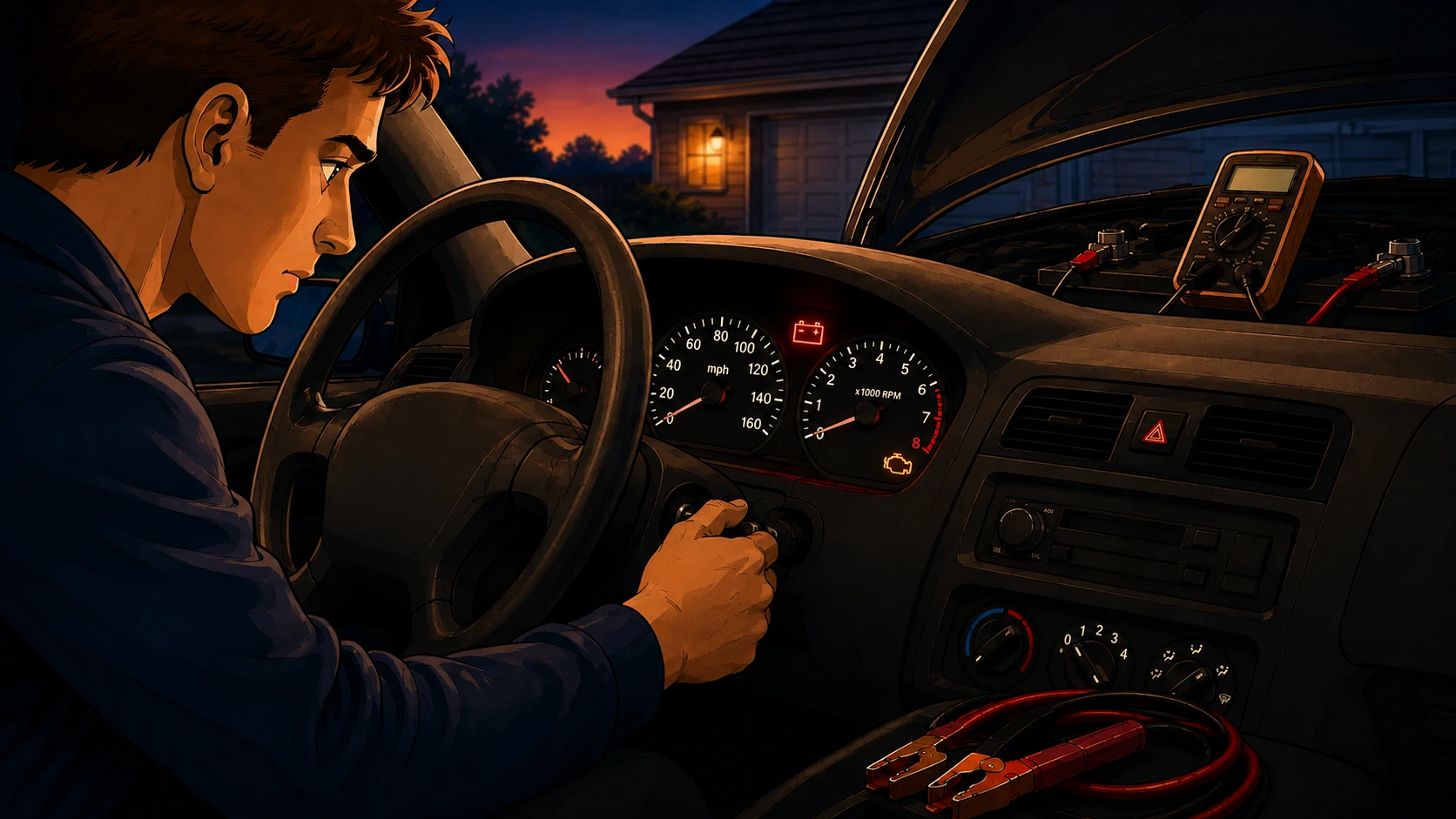
Listen to what happens when you turn the key. Complete silence with no dash lights means a dead battery or loose terminal. Rapid clicking means the battery is too weak to spin the starter. A single loud click means the starter motor has failed. Cranks but won't fire usually points to fuel or spark, not the starting system. Cranks slowly with bright lights means the starter is dying. The right diagnosis takes 60 seconds and saves $200 to $700 over throwing parts at it.
The 60-Second Diagnostic Every Driver Should Know
A no-start situation is the single most common roadside breakdown in North America. The good news is that 90 percent of no-starts come from one of three components: the battery, the starter motor, or the alternator. Each leaves a distinct fingerprint in the sounds, lights, and behavior of your car at the moment you turn the key. Reading those fingerprints correctly is the difference between a $0 jump-start and a $700 wrong-part repair bill.
This guide is built as a decision tree. Start at the top, listen and look for the symptom that matches your car, then jump to the matching section for a 30-second test and a link to the full repair guide. Bring a multimeter if you have one. If not, your ears will get you most of the way there.
The number one rule: never throw a part at the problem before you confirm what is broken.
The Listen and Look Decision Tree
Turn the key (or push the start button) and pay attention to these two things:
- What sound does the car make? Silence, click, rapid clicks, slow crank, or normal crank?
- What do the dashboard lights and headlights do? Stay bright, dim, flicker, or stay completely off?
Match your symptom to one of the five scenarios below.
Scenario 1: Complete Silence, No Dash Lights
What it means: The battery is fully dead or a connection is broken. There is not enough juice to even illuminate the dashboard.
30-second test: Open the hood and look at the battery terminals. Are they covered in white, blue, or green corrosion? Are they loose? Wiggle each cable. If the dash flickers when you wiggle, you have a loose or corroded connection. If still dead, the battery itself is dead or has failed internally.
The fix:
- Clean corroded terminals with a wire brush and baking soda paste
- Tighten loose terminals with a wrench
- Try a jump-start using our step-by-step jump start guide
- If the battery is more than 4 years old and refuses a jump, replace it
Scenario 2: Rapid Clicking When You Turn the Key
What it means: The battery has just enough power to engage the starter solenoid but not enough to spin the starter motor. The solenoid pulls in, voltage drops, the solenoid releases, voltage recovers, and the cycle repeats dozens of times per second. This is the sound of a discharged or dying battery 95 percent of the time.
30-second test: Turn on the headlights and look. If they are dim or dark, the battery is the culprit. With a multimeter, check voltage at the battery terminals. A healthy battery reads 12.6 volts at rest. Below 12.0 volts, the battery is too discharged to start the engine.
The fix:
- Jump-start the car and drive at least 30 minutes at highway speed to recharge
- If the battery dies again within a day or two, the battery has failed internally and needs replacement
- If a new battery dies repeatedly, the alternator is not charging. See Scenario 5 below
- Walk through full diagnostics with our battery troubleshooting guide
Scenario 3: One Loud Click, Then Nothing
What it means: The battery is delivering full power. The solenoid pulls in normally (that is the click). But the starter motor itself does not spin. The brushes inside the starter are worn out or the motor windings are dead. This is classic starter motor failure.
30-second test: Turn on the headlights and try to start. If the headlights stay bright but you only hear one click, the starter is the problem. As a confirmation trick, gently tap the starter housing with a small hammer or wrench while someone turns the key. If it cranks once, the brushes are stuck. The starter is on borrowed time.
The fix: Replace the starter motor. This is one of the highest-payoff DIY jobs you can do. Plan 1 to 3 hours and save $300 to $600 over a shop. Walk through it with our starter motor replacement guide.
Scenario 4: Cranks but Won't Fire
What it means: The starting system (battery, starter, wiring) is healthy. The engine is spinning normally. But it never catches and fires. This is not a starting-system problem at all. It is a fuel, spark, or air problem.
Common causes in order of likelihood:
- Out of fuel. Yes, really. Check the gauge first.
- Failed fuel pump. Listen for a faint humming sound from the fuel tank when you first turn the key to ON. No hum means the pump is dead.
- Bad ignition coil or fouled spark plugs. See our spark plug replacement guide.
- Clogged fuel filter. See our fuel filter replacement guide.
- Crank position sensor failure. The engine spins but the computer cannot time the spark.
The fix: Pull the trouble codes with an OBD2 scanner. Most modern cars store a code that points directly at the failed component. See our OBD2 scanner guide for how to read codes yourself.
Scenario 5: Cranks Slowly and Bright Lights
What it means: The battery has enough power for accessories but the starter is dragging or the battery cannot deliver the high current needed to crank quickly. This often points to one of three things: a worn starter, a bad battery cable, or a battery that is on its last legs.
30-second test: With the engine off, measure battery voltage. Should read 12.4 to 12.7 volts. Then have someone crank the engine while you watch the multimeter. If voltage drops below 9.6 volts during cranking, the battery is failing. If voltage stays above 11 volts but the engine cranks slowly, the starter or its cables are the problem.
The fix: Test the battery first (free at any auto parts store). If the battery passes, inspect the heavy battery cables for corrosion, damage, or loose connections at both ends. If cables and battery are good, the starter is dragging and needs replacement.
When to Suspect the Alternator
The alternator only matters once the engine is running. It charges the battery and powers the electrical system. A dead alternator will not stop you from starting the car the first time, but the battery will go dead within a few hours and you will not be able to restart.
Telltale signs of alternator failure:
- Battery warning light glows on the dash while driving
- Headlights dim at idle and brighten when you rev
- Battery dies within hours of replacement
- Whining noise from the front of the engine
30-second test: Start the engine and measure voltage at the battery terminals with the engine running. Should read 13.6 to 14.6 volts. Below 13.6 volts means the alternator is not charging. Above 14.6 volts means it is overcharging and will boil the battery dry. Either condition needs a replacement. See our alternator replacement guide.
THE FREE PARTS-STORE TEST
Most major auto parts chains (AutoZone, O'Reilly, Advance, NAPA) will test your battery, alternator, and starter for free in their parking lot. If you can drive there or jump-start to get there, do this before buying any parts. It takes 10 minutes and removes all guesswork.
Repair Cost at a Glance
| Repair | DIY Cost | Shop Cost |
|---|---|---|
| Jump start | $0 (free) | $50-150 (roadside) |
| Clean terminals | $5 | $40-80 |
| Battery replacement | $120-250 | $200-400 |
| Starter motor | $90-300 | $400-900 |
| Alternator | $150-400 | $400-1,000 |
STILL STUCK? GET HELP
If you have worked through all five scenarios, run the parts-store tests, and your car still refuses to start, the problem is likely in the immobilizer, ignition switch, or fuel system. These need a professional scan tool to diagnose. Tow the car rather than throwing more parts at it.
Prevent the Next No-Start
- Test the battery every spring and fall. Free at any auto parts store.
- Keep terminals clean. A 5-minute wire brush cleaning every 6 months prevents most no-starts.
- Replace the battery at 4 to 5 years regardless of how it tests. Internal failure is sudden and total.
- Drive at least 20 minutes weekly. Short trips never let the alternator fully recharge the battery.
- Carry jumper cables or a portable jump pack. Get back on the road in 10 minutes with our jump start guide.
WHY THIS MATTERS
According to AAA's 2024 roadside report, AAA fielded over 27 million emergency calls in 2024. Battery and starting-system failures alone accounted for roughly 7 million of them, more than any other category. Two minutes of monthly maintenance prevents most of these breakdowns.
BOTTOM LINE
Diagnose before you spend. Silence means battery. Rapid clicks mean weak battery. One loud click means starter. Cranks but no fire means fuel or spark. Slow crank means dying battery or starter. Once you know what is broken, the repair is half the battle and saves you $200 to $700 over a parts-cannon approach.
What to Read Next
Best OBD2 Scanners for 2026
Pinpoint the cause yourself. Picks from $25 to $500.
Battery Troubleshooting
Voltage tests, load tests, and when to replace.
Starter Motor Replacement
Save $300 to $600 on a 1 to 3 hour DIY job.
Alternator Replacement
Diagnose and replace a failing alternator before it strands you.
How to Jump Start a Car
Safe technique to get moving in 10 minutes.
Frequently Asked Questions
Don't Miss Critical Car Care Tips
Get exclusive guides, money-saving maintenance tips, and early warning signs delivered straight to your inbox.