Best Jump Starters & Jumper Cables for Dead Car Batteries (2026)
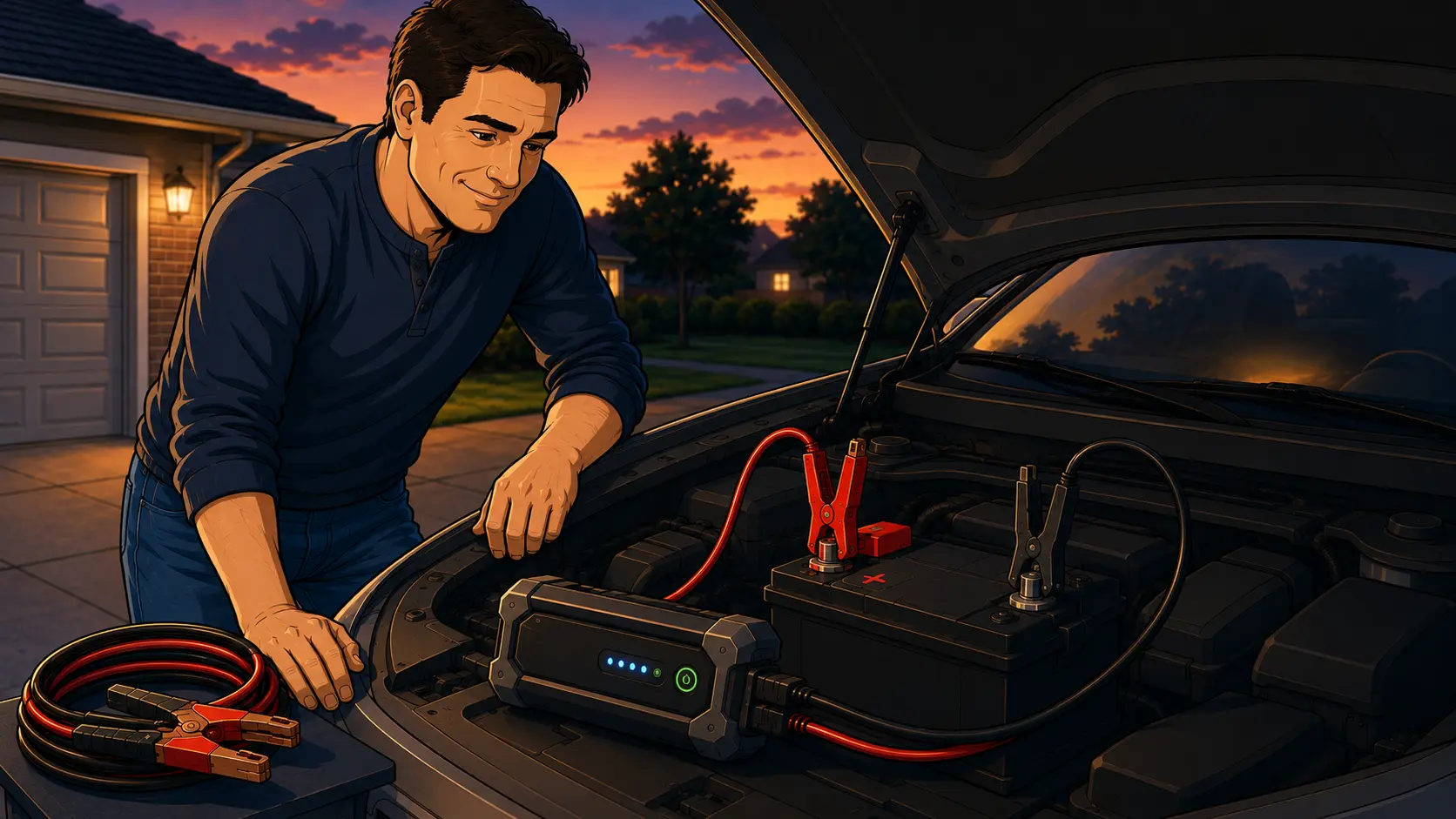
Quick Answer
For most drivers, a 1000A portable lithium jump starter in the NOCO GB40 class ($80 to $130) is the right pick. It jumps any standard gas car solo, doubles as a USB power bank, and fits in the glove box. Truck and diesel owners should step up to a 2000A heavy-duty pack. Pair either one with a smart battery maintainer to roughly double battery lifespan.
Stop Waiting in Parking Lots for a Stranger With Cables
A dead battery is the single most common reason a car will not start. The fix used to mean calling for roadside or hoping a passerby had cables. In 2026 a $100 lithium pack the size of a paperback book solves it solo in under a minute. This guide walks through five products that cover every scenario: jumping the car right now, jumping a heavy truck, jumping on a budget, preventing the next dead battery, and diagnosing why it died in the first place.
How We Picked
We started with the gear our editors actually keep in their own vehicles, then cross-referenced thousands of verified buyer reviews across the US and German Amazon stores. Picks had to clear five bars:
- →Actually starts dead cars: tested CCA matches the spec sheet, not just marketing peak amps.
- →Idiot-proof safety: reverse-polarity, spark, and short-circuit protection on every electronic unit.
- →Holds charge in storage: what good is a jump pack that dies in your glove box?
- →Cold-weather tested: a dead battery in July is annoying. In January it is dangerous.
- →Brands that stand behind warranty: we excluded units from sellers with poor RMA records.
As an Amazon Associate we earn from qualifying purchases at no extra cost to you. Learn more.
Our Top 5 Picks
Portable Lithium Jump Starter (NOCO GB40 style)
If you only buy one piece of dead-battery gear, make it this. A pocket-size 1000A lithium pack jumps almost any gas car or small SUV without needing a second vehicle. Built-in spark protection and reverse-polarity protection mean even a nervous first-timer cannot fry anything.
What we like
- Jump-starts a dead car solo, no second vehicle needed
- Doubles as a USB power bank and LED flashlight
- Spark and reverse-polarity protected
- Holds charge for a year or longer in the glove box
Watch out for
- Not enough power for diesels over 3.0L
- Lithium does not like extreme cold storage
Best for: Daily drivers, commuters, and anyone who has ever waited for a jump from a stranger.
Check price on AmazonAffiliate link. We may earn a small commission at no extra cost to you. Learn more.
Heavy-Duty Jump Starter (NOCO GB70 style)
When your daily is a 6.7L Cummins, F-250, or fully loaded Suburban, small packs run out of cranking amps. The 2000A class handles big-displacement gas and most diesel engines down to about minus 4 F. Worth it if you tow, plow, or work fleets.
What we like
- 2000A peak handles diesels and big V8s
- Cold-weather performance is noticeably better
- Same safety features as the smaller pack
- Recharges fast over USB-C
Watch out for
- Heavier and pricier
- Overkill for a Civic or a Corolla
Best for: Truck owners, RV travelers, diesel drivers, and anyone in a cold climate.
Check price on AmazonAffiliate link. We may earn a small commission at no extra cost to you. Learn more.
Heavy-Duty 4-Gauge Jumper Cables (20 ft)
Old-school cables still work if you can find a Good Samaritan. Skip the cheap 8-gauge sets that feel like spaghetti. A real 4-gauge, 20-foot set delivers the amps a stone-dead battery actually needs and reaches across most parking spaces.
What we like
- Cheapest dead-battery insurance you can buy
- 20 ft length reaches odd parking angles
- Heavy 4-gauge copper actually transmits current
- Will outlive your car
Watch out for
- Requires a second vehicle and a willing driver
- Easy to connect backwards if you are stressed
- Bulky to coil and store
Best for: Backup gear in the trunk, second-car households, or budget-first buyers.
Check price on AmazonAffiliate link. We may earn a small commission at no extra cost to you. Learn more.
Smart Battery Charger / Maintainer (NOCO Genius style)
The cheapest way to avoid ever needing a jump is to never let the battery die. A smart maintainer plugged into a garage outlet keeps the battery topped up, desulfates plates, and extends battery life by years. Essential for weekend cars, motorcycles, and any vehicle that sits.
What we like
- Doubles average battery life
- Safe to leave connected long term
- Desulfation mode revives tired batteries
- Works on AGM, lithium, and standard lead-acid
Watch out for
- Needs access to a power outlet
- Will not help you in a parking lot
Best for: Garage owners, weekend project cars, RVs, boats, motorcycles, and cold-winter parkers.
Check price on AmazonAffiliate link. We may earn a small commission at no extra cost to you. Learn more.
Digital Battery Load Tester (12V CCA)
If your car needs a jump twice in one week, the battery is the suspect, not the alternator. A 30-second load test confirms CCA health and prevents wasted replacement parts. Use it once a season to catch a dying battery before it leaves you stranded.
What we like
- Confirms battery health in under a minute
- Stops you wasting money on a starter or alternator
- Tests CCA against the rated value on the battery
- Some models check alternator output too
Watch out for
- Reads vehicle batteries only
- Cheap units have flexy plastic clamps
Best for: DIYers troubleshooting repeated no-start issues or planning a road trip.
Check price on AmazonAffiliate link. We may earn a small commission at no extra cost to you. Learn more.
Which One Should You Actually Buy?
Match yourself to the scenario closest to your real life.
"I drive a normal car and never want to be stranded."
Buy the portable lithium pack. Charge it once, drop it in the glove box, forget about it for a year.
"I drive a diesel, tow a trailer, or live where it gets really cold."
Buy the heavy-duty 2000A pack. The extra cranking amps matter on the coldest morning of the year.
"I have a second car and a tight budget."
Buy the heavy-duty jumper cables. Stash a set in each trunk. Total cost under sixty dollars.
"My car sits in the garage for weeks at a time."
Buy the smart maintainer first. Prevention beats rescue every time, and it doubles battery life.
"This is the third jump in a month."
Buy the load tester. The battery is almost certainly toast. Confirm it before you replace the wrong part.
How to Use a Portable Jump Starter (90 Seconds)
- Put the car in Park (automatic) or Neutral (manual) with the ignition OFF and the key out.
- Connect the red clamp to the positive (+) battery terminal.
- Connect the black clamp to an unpainted engine ground bolt, not the negative battery terminal.
- Power on the jump pack. The indicator light should turn green.
- Start the car. If it does not catch in 5 seconds, wait 30 seconds and try again.
- Once it starts, disconnect black first, then red. Drive for at least 20 minutes to recharge the battery.
Need the full walkthrough with photos and troubleshooting? See our complete jump-start guide.
A JUMP IS A RESCUE, NOT A REPAIR
If the battery dies once, it could be a left-on light. Twice in a week and the battery is dying or there is a parasitic drain. Three times and you risk being stranded. Use the diagnostic pick to confirm CCA health, then replace the battery or chase the drain before it leaves you stuck somewhere worse than your own driveway.
What to Read Next
Diagnosis
Car Won't Start: Battery, Starter, or Alternator?
A 60-second decision tree to pinpoint the cause.
Prevention
Car Battery Maintenance Guide
Double your battery's life with five simple habits.
How-To
How to Jump-Start a Car (Step-by-Step)
Cables or pack, the safe order to connect and disconnect.
Diagnosis
Troubleshooting Battery Issues
Find a parasitic drain before it kills another battery.
Frequently Asked Questions
Don't Miss Critical Car Care Tips
Get exclusive guides, money-saving maintenance tips, and early warning signs delivered straight to your inbox.