How to Ship Car Parts: The Complete Packaging and Shipping Guide
Quick Answer
Use USPS Priority Mail for parts under 5 lbs ($8 to $15), FedEx Ground for 5 to 70 lbs ($12 to $30), and freight shipping for items over 70 lbs. Double-box fragile parts like headlights with 2 inches of bubble wrap on all sides. Always insure shipments over $50 and use tracking on every package.
Shipping car parts is one of the biggest pain points for online sellers. Get it wrong and you are dealing with damaged items, return requests, negative reviews, and lost profit. Get it right and you build a reputation for reliability that keeps buyers coming back. This guide covers packaging methods for every part type, carrier comparisons, dimensional weight pricing, and the insurance strategies that protect your margins.
The Golden Rules of Shipping Car Parts
Three rules separate profitable car parts sellers from those drowning in returns. First, always double-box heavy or fragile items. Second, photograph everything before sealing the package as proof of condition. Third, never underestimate dimensional weight pricing, which is how carriers calculate cost for large but lightweight items. Follow these three rules and you will eliminate 90% of shipping headaches.
Quick Carrier Cheat Sheet
Under 1 lb (sensors, switches, small electronics): USPS First Class Mail ($3-5)
1-10 lbs (alternators, starters, pumps): USPS Priority Mail or UPS Ground ($8-20)
10-70 lbs (transmissions, engines, body panels): UPS Ground or FedEx Ground ($15-50+)
Over 70 lbs or oversized: Freight shipping via uShip or FedEx Freight ($50-200+)
Why Proper Packaging Saves Your Business
A damaged part costs you three times. You lose the sale, you pay return shipping, and the buyer leaves a negative review that scares off future customers. On eBay Motors, sellers with damage claims above 2% see their listings pushed down in search results. The $2 you save by skipping bubble wrap can cost you $200 in lost future sales.
Professional auto parts resellers budget 5% to 10% of the sale price for packaging materials. That sounds like a lot until you compare it to the 15% to 25% loss from a single damage return. Treat packaging as an investment, not an expense.
Essential Packaging Supplies
Keep These In Stock
- •Heavy-duty corrugated boxes (double-wall for heavy parts)
- •Bubble wrap (large bubble for heavy items, small bubble for electronics)
- •Packing peanuts or crumpled kraft paper
- •Stretch wrap for securing parts inside boxes
- •Packing tape (minimum 2 inches wide, heavy-duty)
- •Zip-lock bags for small hardware and bolts
- •Foam padding or pool noodles for fragile edges
Pro tip: Buy supplies in bulk from Uline or Amazon. A case of boxes costs 60% less per unit than buying individually.
How to Package and Ship Car Parts: Step by Step
Clean and Photograph the Part
Clean parts sell for more and photograph better. Grease-covered items also risk soiling the packaging, which can lead to carrier surcharges or damage claims.
- Wipe down the part to remove grease, dirt, and debris
- Take 4 to 6 clear photos showing all sides, connectors, and any wear
- Include a photo of part numbers and labels for buyer verification
- Save photos as proof of pre-shipping condition (keep for 60 days minimum)
Choose the Right Box and Padding
The box should be at least 2 inches larger than the part on all sides to allow room for padding. Too tight and there is no crush protection. Too large and you pay more for dimensional weight.
- Use double-wall corrugated boxes for items over 10 lbs
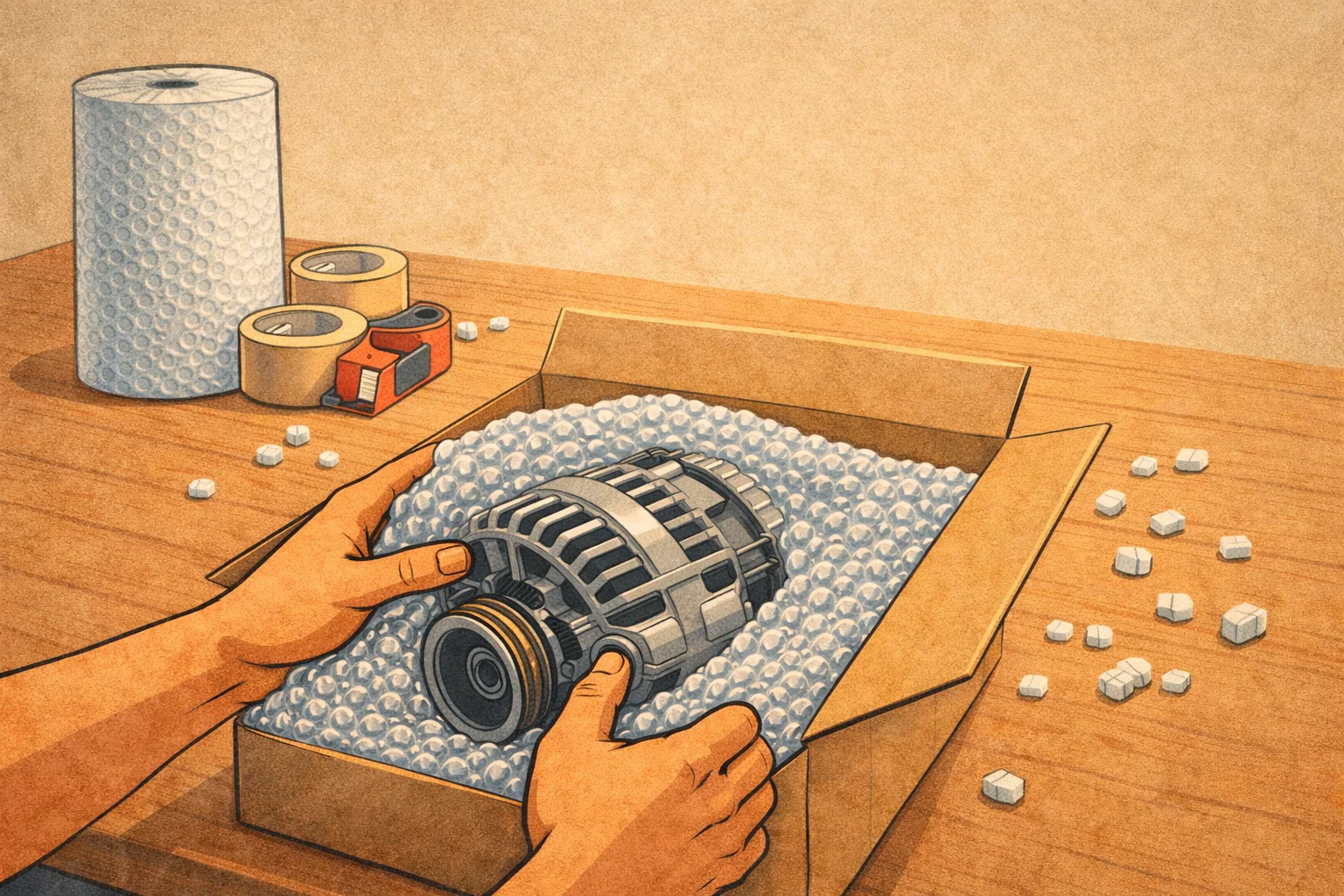
- For heavy metal parts (alternators, calipers), double-box: place the wrapped part in a snug inner box, then place that inside a larger outer box with padding between them
- Wrap fragile components (sensors, ECUs, glass) in at least 2 inches of bubble wrap
- Fill all empty space so the part cannot shift when the box is shaken
- Place small hardware (bolts, clips, brackets) in labeled zip-lock bags taped to the main part
Package by Part Type
Different parts have different vulnerabilities. Here is how to handle the most common categories.
Heavy Metal Parts (Alternators, Starters, Pumps)
- Wrap in stretch wrap first to keep loose components together
- Then wrap in large-bubble bubble wrap
- Double-box with 2 to 3 inches of packing peanuts between boxes
- Reinforce box corners and seams with extra tape
Electronics (ECUs, Sensors, Modules)
- Use anti-static bags for circuit boards and electronic modules
- Wrap in small-bubble bubble wrap (at least 3 layers)
- Place in a snug box with foam padding on all sides
- Mark the box "FRAGILE" and "THIS SIDE UP"
Body Panels and Trim
- Protect painted surfaces with foam padding or moving blankets
- Wrap edges with pool noodles or foam tubing to prevent chips
- Use flat cardboard sandwiches for thin panels: cardboard, part, cardboard, then tape together
- Consider custom crating for expensive or oversized panels
Weigh and Measure for Accurate Pricing
Carriers charge by actual weight or dimensional weight, whichever is greater. If you do not calculate this upfront, you will either overcharge buyers (losing sales) or undercharge yourself (eating into profit).
- Weigh the fully packaged box on a bathroom or shipping scale
- Measure the box length, width, and height in inches
- Calculate dimensional weight: (L x W x H) / 139 for UPS and FedEx
- The carrier charges based on whichever number is higher
- Round up to the next pound when entering weight in shipping calculators
Dimensional Weight Example
Choose the Right Carrier and Service
Each carrier has strengths for different part types and weights. Choosing wrong can double your shipping cost.
| Carrier | Best For | Max Weight | Cost Range |
|---|---|---|---|
| USPS First Class | Under 1 lb (sensors, switches) | 15.99 oz | $3-5 |
| USPS Priority Mail | 1-10 lbs, Flat Rate boxes | 70 lbs | $8-20 |
| UPS Ground | 10-50 lbs, dimensional items | 150 lbs | $12-40 |
| FedEx Ground | Similar to UPS, good discounts | 150 lbs | $12-40 |
| Freight (uShip) | Engines, transmissions, pallets | No practical limit | $50-200+ |
Pro tip: USPS Priority Mail Flat Rate boxes are a hidden gem for heavy small parts. A Medium Flat Rate Box holds up to 70 lbs for about $16. An alternator fits perfectly.
Add Insurance and Tracking
Skipping insurance on a $150 alternator to save $3 is a gamble that eventually loses. Always insure shipments worth $50 or more.
- USPS includes $100 insurance with Priority Mail at no extra cost
- UPS and FedEx include $100 declared value by default
- For items over $100, add declared value coverage (typically $0.50 to $1.00 per $100)
- Always use a service with tracking included (all major carriers offer this)
- Share the tracking number with the buyer immediately after shipping
Print Labels and Ship
Where you buy your shipping label affects your cost significantly. Never pay retail counter rates if you can avoid it.
- eBay shipping labels save 20% to 30% compared to retail counter prices
- Pirate Ship offers the same USPS Commercial rates as eBay for free (great for Marketplace sales)
- UPS and FedEx offer volume discounts if you open a business account
- Schedule free UPS or FedEx pickups from your home or workshop
- For eBay sales, always use eBay labels for automatic tracking upload and seller protection
eBay Shipping Labels vs. Self-Shipping
If you sell on eBay Motors, always use eBay's integrated shipping labels. You get Commercial Plus pricing (the deepest USPS discounts), automatic tracking upload, and eBay seller protection for items shipped through their system. Self-shipping with a separately purchased label means you lose seller protection if a buyer claims the item was not received.
For Facebook Marketplace and local sales, Pirate Ship is the best option for USPS labels. It is free to use and offers the same Commercial rates as eBay. For UPS and FedEx, open a free business account to access negotiated rates that are 15% to 30% below retail.
Handling Returns and Damage Claims
Protect Yourself From Return Fraud
If a part arrives damaged, file a claim with the carrier immediately. You will need your pre-shipping photos, the tracking number, and the buyer's photos of the damage. Most carriers require claims within 60 days of delivery. For insured shipments, the carrier covers the declared value minus any deductible.
For eBay returns, respond within 24 hours and offer a prepaid return label. Fast, professional responses to returns actually improve your seller metrics and search ranking. A return handled well can turn into a repeat customer.
5 Shipping Mistakes That Kill Your Profit
- Using the wrong box size. An oversized box means you pay dimensional weight prices on a light item. A too-small box means no room for padding and higher damage risk.
- Skipping the double-box for heavy parts. A 15 lb alternator in a single-wall box will punch through the corner during transit. Double-box anything over 10 lbs.
- Not calculating dimensional weight. That "small" $8 shipping charge can become $22 when the carrier recalculates based on box dimensions.
- Shipping fluids without containment. Oil-filled parts (power steering pumps, compressors) must be drained and residual fluid contained in sealed bags. Leaking packages get surcharges and damage other items.
- Paying retail shipping rates. Always use eBay labels, Pirate Ship, or a business account. Retail counter prices are 20% to 40% higher.
Complete Your Selling Strategy
Shipping is one piece of the selling puzzle. These related guides help you maximize profit across the entire process.
- Where to Sell Car Parts for platform comparison and seller strategies
- How to Part Out a Car for dismantling and identifying high-value components
- How to Price Used Car Parts for research-based pricing strategies
- Selling Your Car for Scrap for understanding when to sell whole vs. part out
Frequently Asked Questions
Don't Miss Critical Car Care Tips
Get exclusive guides, money-saving maintenance tips, and early warning signs delivered straight to your inbox.