How to Price Used Car Parts for Maximum Profit
Quick Answer
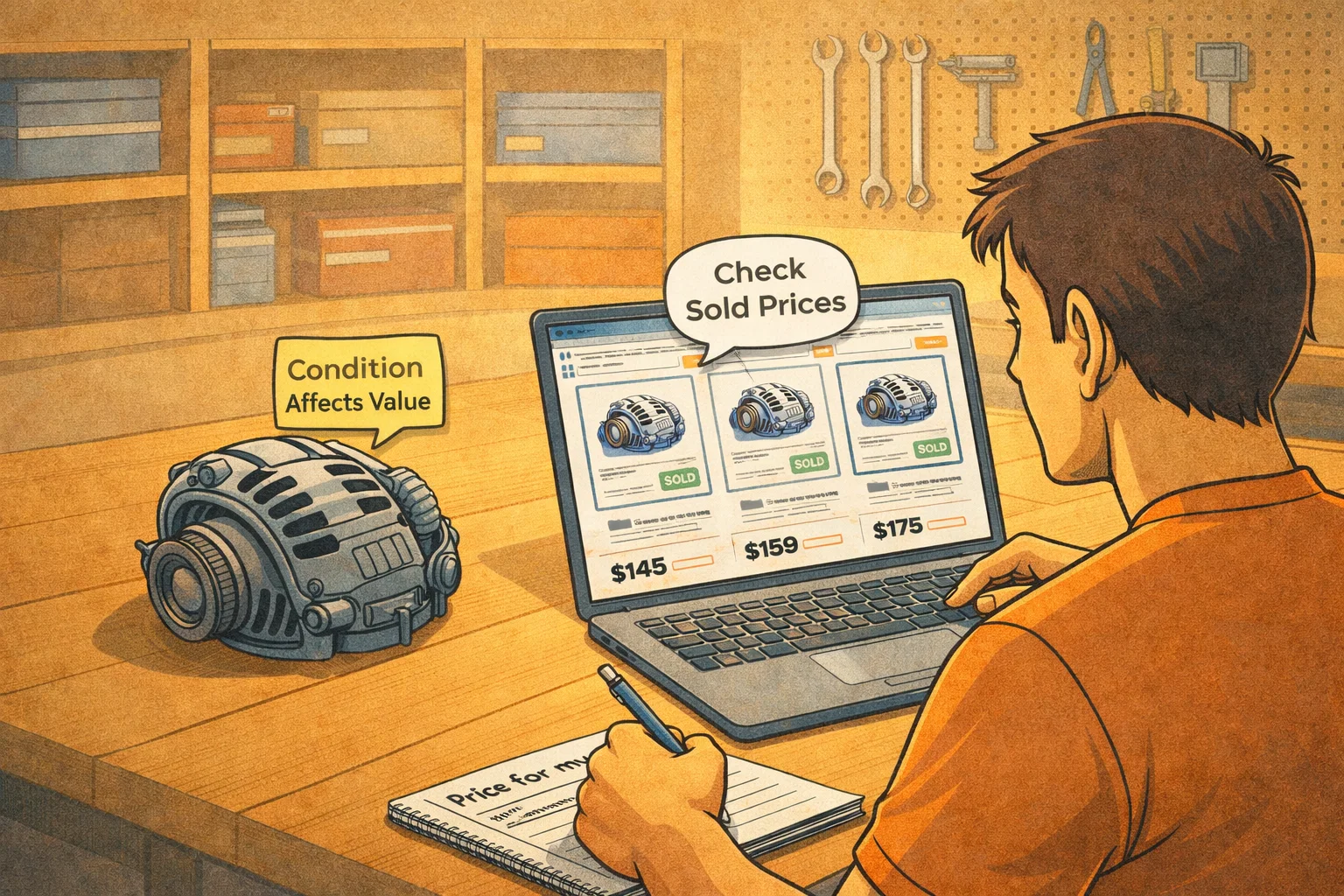
Price used car parts by checking eBay sold listings (filter by 'Sold Items') and Car-Part.com for market rates. Price 10 to 15% below the lowest comparable listing for fast sales, or match the median for maximum profit. Grade parts honestly (A, B, C condition) and include clear photos of any flaws.
Pricing used car parts is where most sellers leave money on the table. Price too high and parts sit for months collecting dust. Price too low and you are basically donating inventory. The right price comes from research, not guessing. This guide shows you exactly how to use eBay sold listings, Car-Part.com, and condition grading to set prices that sell fast while maximizing your profit.
The 3 Pricing Principles That Maximize Profit
Three principles separate profitable parts sellers from hobbyists. First, always research what your part actually sold for, not what other sellers are asking. Asking prices mean nothing because unsold listings tell you nothing about demand. Second, condition is king. A Grade A part in excellent condition sells for 2 to 3 times more than the same part in Grade C condition. Third, platform matters. The same alternator can sell for $80 on Facebook Marketplace and $140 on eBay because eBay buyers expect to pay more for the convenience of shipping and buyer protection.
Pricing Quick Formula
Step 1: Find the average eBay sold price for your exact part (same make, model, year)
Step 2: Adjust for condition (Grade A: use average price, Grade B: minus 20%, Grade C: minus 40%, Grade D: minus 60%)
Step 3: Adjust for platform (eBay: use adjusted price, Facebook Marketplace: minus 15-20%, Local pickup: minus 25-30%)
This formula gets you within 10% of the optimal price for most parts.
Step-by-Step Pricing Research
Check eBay Sold Listings
eBay sold listings are the single most valuable pricing tool for used car parts. They show you what buyers actually paid, not what sellers hope to get.
- Search eBay for your part using the exact part number if available
- If no part number, search by year, make, model, and part description
- Click "Sold Items" under the filter options (this is critical)
- Look at the last 10 to 20 sold listings for your part
- Note the average selling price and the range (lowest to highest)
- Pay attention to listing descriptions: condition details affect the price dramatically
Pro Tip: Use Part Numbers
Cross-Reference on Car-Part.com
Car-Part.com aggregates pricing from over 7,500 salvage yards and recyclers across North America. It shows you the wholesale market price for used parts.
- Search by year, make, model, and part category
- Results show asking prices from multiple salvage yards
- These prices represent the wholesale or "floor" price
- Your retail selling price should be 30% to 80% above Car-Part.com prices
- If no results appear, your part may be rare (which means higher value)
Compare New Part Prices on RockAuto
Knowing the new price establishes the ceiling for your used part. Buyers will not pay 80% of new for a used part unless it is rare or discontinued.
- Search your part on RockAuto to find the new aftermarket price
- A fair used part price is typically 30% to 60% of the new aftermarket price
- OEM parts in excellent condition can command 50% to 70% of new OEM price
- If the new part costs under $30, selling used may not be worth the effort after fees and shipping
Grade the Part's Condition
Condition grading is what separates a $60 sale from a $140 sale. Use this standard grading system to accurately describe and price your parts.
| Grade | Description | Price Adjustment |
|---|---|---|
| A (Excellent) | Like new or minimal wear. Fully functional. No cosmetic damage. All connectors intact. | Full average sold price |
| B (Good) | Normal wear for age and mileage. Fully functional. Minor cosmetic marks. All connectors intact. | Average minus 20% |
| C (Fair) | Visible wear, minor cosmetic damage. Functional but may need cleaning or minor repair. Some cosmetic issues. | Average minus 40% |
| D (Poor/Core) | Heavy wear or damage. Sold as-is for rebuilding or core exchange. May not be fully functional. | Average minus 60% |
Set Your Price by Platform
Different platforms have different buyer expectations, fee structures, and competitive landscapes. Adjust your price accordingly.
eBay Motors
- Use your research-based price (condition-adjusted average sold price)
- Factor in eBay's 13% final value fee when setting your minimum acceptable price
- Consider offering "Best Offer" at 10% to 15% above your minimum to capture negotiators
- Free shipping listings rank higher, so build shipping into the item price
Facebook Marketplace
- Price 15% to 20% below your eBay price (no platform fees for local sales)
- Expect buyers to negotiate 10% to 20% below your listed price
- Set your listing price 15% above your actual target to leave room for negotiation
- Specify "firm" in the listing if you do not want to negotiate
Local Sale (Craigslist, In-Person)
- Price 25% to 30% below eBay prices (no fees, no shipping, instant cash)
- Cash-only keeps things simple and avoids payment fraud
- Meet in a public place for safety
Parts That Consistently Sell for Top Dollar
Not all used car parts are created equal. Some categories consistently command premium prices because of high new-part costs, dealer-only availability, or strong demand from specific vehicle communities.
| Part Category | Typical Used Price | Why It Sells Well |
|---|---|---|
| ECU / PCM modules | $100-400 | New units cost $500-1,500+. Vehicle-specific programming. |
| Headlight assemblies | $80-300 | New OEM units cost $300-1,000. High demand after accidents. |
| Turbochargers | $200-800 | New units cost $800-2,500+. Core return programs add value. |
| Transmission assemblies | $300-1,500 | Rebuilds cost $1,500-4,000. Used units save buyers thousands. |
| Catalytic converters | $100-500 | Precious metal content. New units cost $500-2,000+. |
| Instrument clusters | $75-250 | Model-specific, hard to find. OEM replacements are expensive. |
Want to know which parts to pull first when parting out a car? Our part-out guide covers the complete priority list.
Negotiation Tactics for Maximum Profit
Most buyers will try to negotiate, especially on Facebook Marketplace and Craigslist. Smart sellers plan for this from the start.
- Set your listed price 15% above your target. This gives you room to "give a discount" while still hitting your number. Buyers feel like they won, and you get the price you wanted.
- Respond to lowball offers with a counter, not a rejection. If someone offers $50 on a $120 part, counter with $100. Many lowballers will settle in the middle.
- Bundle for volume discounts. If you have multiple parts from the same vehicle, offer 10% to 15% off when a buyer takes two or more items. You save on individual shipping and clear inventory faster.
- Use "OBO" strategically. Adding "or best offer" to eBay listings increases views and bids. Set a minimum auto-accept price and a minimum auto-decline price to filter out lowballers.
- Time your listings. Parts sell faster in the spring and summer when people are working on their cars. Winter listings may need lower prices to move.
5 Pricing Mistakes That Cost You Money
Avoid These Traps
1. Pricing based on asking prices instead of sold prices. What people ask for is irrelevant. What people actually pay is the only data point that matters.
2. Ignoring platform fees. eBay takes about 13% in final value fees. If you price at $100, you net $87. Price at $115 to actually receive $100.
3. Overgrading condition. Calling a Grade C part "excellent" leads to returns, negative reviews, and wasted shipping costs. Be honest and let your photos prove the condition.
4. Not accounting for shipping costs. A part that sells for $50 but costs $25 to ship leaves you with $25 minus fees. Make sure your price covers the total cost of doing business.
5. Sitting on slow inventory too long. If a part has not sold in 60 days, drop the price by 15% to 20%. A part in your garage earns nothing. A part sold at a discount still makes money.
Complete Your Selling Strategy
Pricing is just one part of a successful car parts selling operation. These related guides cover the full picture from platform selection to packaging and shipping.
- Where to Sell Car Parts for platform comparison and audience targeting
- How to Ship Car Parts for packaging and carrier strategies
- How to Part Out a Car for dismantling and identifying valuable components
- Selling Your Car for Scrap for understanding when to scrap vs. part out
Frequently Asked Questions
Don't Miss Critical Car Care Tips
Get exclusive guides, money-saving maintenance tips, and early warning signs delivered straight to your inbox.